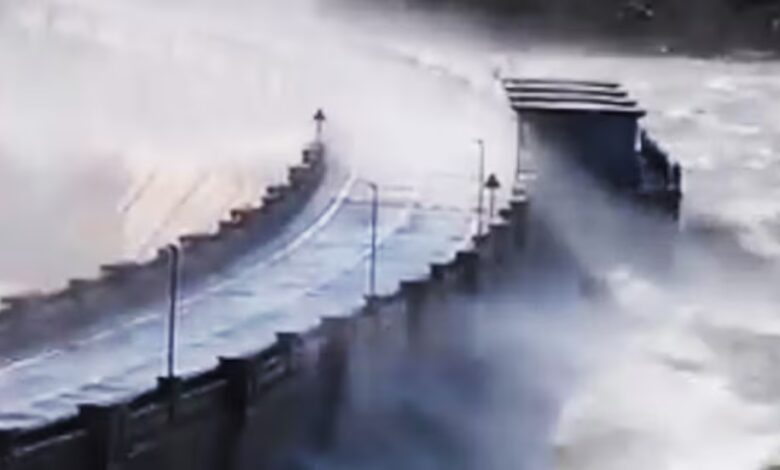
The aftermath of storm Oriana has become a real challenge for residents of Spain. The natural disaster brought not only destructive winds but also record rainfall, leading to the closure of public spaces and disrupting everyday life. This was especially evident in Madrid, where the Navacerrada reservoir turned into a churning sea, and wind gusts reached speeds of 100 km/h.
Catalonia faced tragedy: one woman died, and another 85 people suffered various injuries. Numerous incidents were reported in other regions as well, including falling trees, damaged cars, and disruptions to public transport. Authorities were forced to temporarily close schools, ports, and even Madrid’s historic parks to prevent further casualties and destruction.
Water and wind
In Madrid, an unusual scene attracted attention: the Navacerrada reservoir was battered by powerful waves, a rare occurrence in this region. The water level in the reservoir is now at 83% of its maximum, and water is being released into the Navacerrada River to prevent emergencies. This measure is essential to maintain safety standards and ensure the stability of hydraulic structures.
A series of storms that swept across the country rapidly filled the reservoirs. Most of them, including those in the Madrid region, now hold more than 80% of their capacity. Notably, at the El Villar dam, water levels even reached 104% of the designed volume, forcing emergency water releases.
Restrictions and measures
On Saturday—which coincided with the start of Madrid’s carnival events—authorities decided to close all nine of the city’s historic parks, including the famous El Retiro park. This measure was taken over concerns about possible falling trees and large branches. The restrictions were in place not only over the weekend but extended into Monday due to lingering risks posed by unstable weather.
Abnormal rainfall was reported at a third of Spain’s weather stations, and in some places—such as Grazalema (Cádiz)—historical records were broken. In this city, residents had to be evacuated due to the threat of major flooding. In other regions, like Seville, motorists were affected: one woman was injured when a palm tree fell on her car.
Storms across the country
On Monday, high winds remained a concern along the Catalan coast and in Tarragona, although the intensity of the storm gradually subsided. Official warnings about high waves were lifted, but the consequences of the bad weather will linger for some time.
Such weather disasters have become increasingly common in Spain in recent years. For example, the recent storm Leonardo also triggered mass evacuations, school closures, and road blockages in Andalucía. To learn more about how the natural disaster changed life across the entire region, see the article on the consequences of storm Leonardo in Andalucía.
The surge in extreme weather events in Spain is linked to climate change and atmospheric instability. In recent years, the country has faced hurricanes, heavy rains, and droughts, disrupting infrastructure and forcing mass evacuations. In 2025, similar storms led to port closures and flight cancellations, and some regions experienced power outages. With each new incident, authorities are forced to strengthen safety measures and revise emergency response protocols.