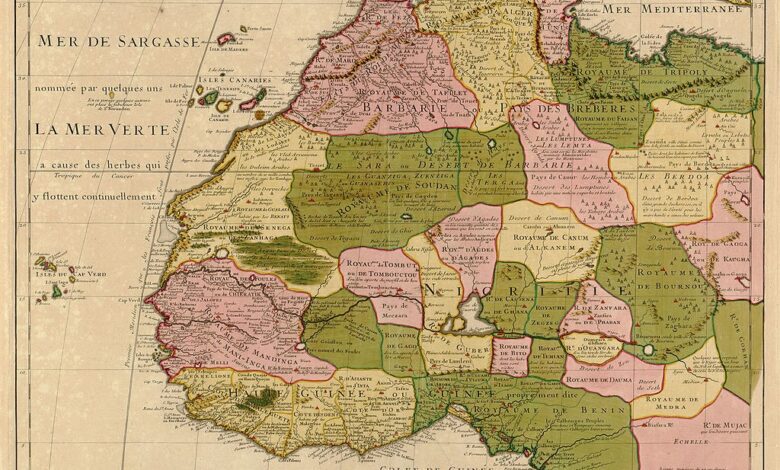
The Canary Islands have long been famous not only for their unique landscapes, but also for their many mysteries. One of the most well-known is the story of the enigmatic island of San Borondón, which, according to legend, appears and disappears in the Atlantic Ocean. For more than seven centuries, this legend has captivated the imagination of people in Spain and researchers from around the world.
The Canary archipelago is usually associated with eight islands: Tenerife, Gran Canaria, Lanzarote, Fuerteventura, La Palma, La Gomera, El Hierro, and La Graciosa. However, in local folklore, a ninth island is mentioned — San Borondón. Locals claim it can sometimes be seen on the horizon, but no one has ever managed to set foot on its land.
The first mention of the mysterious island appeared in the 13th century on the famous Hereford mappa mundi, where it was marked as San Brand. According to these records, if the island actually existed, it would be one of the region’s largest — it was said to be 480 kilometers long and 155 kilometers wide. Despite these impressive dimensions, no expedition has ever managed to find it.
The island’s name is linked to the 6th-century Irish monk known as Brendan the Navigator (San Brandán), who, according to medieval chronicles, once landed on an unknown land in the middle of the ocean. However, as soon as he and his companions thought they had discovered a new island, the land vanished right before their eyes.
Since the 16th century, interest in San Borondón only grew stronger. Expeditions were organized over the years to find the mysterious island. In the late 15th century, Fernando de Viseu, a relative of the famous Portuguese navigator Enrique the Navigator, set out in search. In 1570, the regent of the Royal Audience, Hernán Pérez de Grado, claimed to have reached the island’s shores, but part of his crew went missing. Portuguese sailor Pedro Vello said he managed to land on San Borondón, but due to bad weather he was forced to leave, abandoning two men on the shore. In 1604, Gaspar Pérez de Acosta and the monk Lorenzo de Pinedo returned empty-handed, stating that they only saw clouds on the horizon. The last official attempt was in 1721, when Gaspar Domínguez of Santa Cruz de Tenerife led an expedition, but it also yielded no results.
Skeptics believe that the many reports of the island’s appearance can be explained by atmospheric phenomena. Some researchers suggest that these are mirages caused by light refraction, or dense clouds that sometimes resemble land. There is also a hypothesis about an underwater volcano that could temporarily rise above the sea surface and then submerge again.
Despite all attempts to solve the mystery of San Borondón, in 2025 the island remains one of the most intriguing secrets of the Canary Islands and all of Spain. The legend lives on, attracting tourists, researchers, and enthusiasts of the mystical.