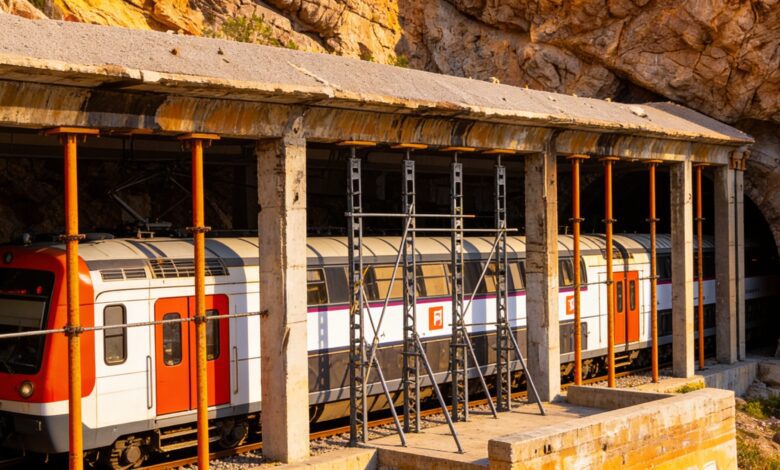
Rail transport in Catalonia faces renewed disruption as a major reconstruction of the Garraf tunnels begins on Monday, leading to significant restrictions on one of the busiest Rodalies lines. According to El Pais, the works are expected to last at least three months and will affect around 80,000 passengers daily. The decision comes amid ongoing disruptions, including the January accident in Gelida and persistent issues elsewhere on the network.
Passengers on the R2 Sur line will see train frequency cut by almost half. Between Sitges and Garraf, only one track will remain open, inevitably causing delays and longer travel times. Between Barcelona and El Prat de Llobregat, there will now be eight trains per hour in each direction, six between Barcelona and Castelldefels, and only four to Garraf. The route to Sant Vicenç de Calders will keep two double trains. Many commuters will face transfers and waiting times, most acutely felt during peak hours.
Alternative routes
Renfe is increasing information services and adding extra trains on the R4 line via Vilafranca del Penedès as a bypass, though this detour will add 40 minutes to travel time. For regional routes, special buses will run between Sant Vicenç and El Prat, as well as additional services connecting Barcelona, Vilanova i la Geltrú, and other affected towns. During rush hours, a new bus route to Altafulla and Torredembarra will add 14,400 seats to the usual offer.
Despite these measures, many passengers express dissatisfaction, arguing that the alternative arrangements do not address real needs or connection times. Representatives of public organizations point out that most routes are forced to channel through El Prat de Llobregat or Bellvitge, where frequent disruptions and delays could lead to a transport collapse.
Parallel difficulties
Problems on Rodalies are not limited to the Garraf repairs. Last week, the Rubí tunnel was completely closed, causing disruptions to freight traffic for up to seven weeks. Over the weekend, strong winds and falling trees halted service on the R11 and RG1 lines between Girona and Figueres. Eastern Catalonia was placed under a red weather alert, but there were no reports of serious injuries.
In addition, a section of a bridge on the R3 line near La Garriga collapsed amid work to widen the tracks. Fortunately, there were no casualties. Against this backdrop, authorities have extended free travel on Rodalies until the end of March to partially offset inconvenience for passengers.
Changes in the urban environment
Starting Monday, Barcelona will reinstate the Zona de Bajas Emisiones (ZBE) regime—restrictions on vehicles without an environmental sticker. This decision follows the Generalitat’s announcement that the reasons for the temporary suspension have ended. The city authorities had lifted restrictions on January 22, but now they are returning to normal.
As El Pais notes, all these measures reflect the complex situation in the region’s transport system, where every new repair or weather event triggers a chain reaction of disruptions and delays. Authorities are forced to respond quickly, but passengers face constant uncertainty and the need to seek alternative routes.
In recent years, Catalonia’s railway network has repeatedly suffered major disruptions due to accidents, weather disasters, and extensive repairs. For example, in 2024, prolonged repairs on the R3 line led to mass transfers to buses and longer travel times for thousands of residents in the region. Similar difficulties have arisen on other routes, when weather conditions or technical failures paralyzed traffic for several days. Such situations highlight the vulnerability of transport infrastructure and the need for long-term investment in its modernization.