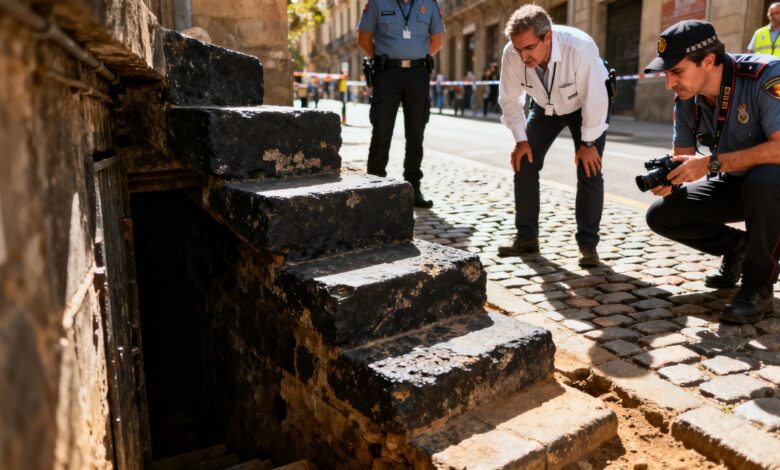
Interest in the history of Barcelona has flared up again after three new entrances to Civil War-era underground shelters were discovered in the Sants-Montjuïc district. These finds not only expand our understanding of the scale of the city’s defensive structures, but also raise questions about the future preservation of Catalonia’s capital’s historical heritage. For residents, this event offers a new perspective on the past and prompts reflection on the role of memory in modern life.
Street improvement works in the Hostafrancs area unexpectedly led to the discovery of three entrances that had not previously appeared in official archives. Each one varies in size and design: the first features a staircase of twelve steps, stretching just over four meters, the second also has twelve steps but is shorter, and the third has fifteen steps yet is slightly shorter in length. All sites were thoroughly examined by specialists from the Barcelona Archaeology Service and members of the Mossos d’Esquadra to rule out any safety risks.
Archaeological details
According to preliminary data, the entrances found may belong to separate shelters or to a single large complex. Experts are currently analyzing the structure of the underground passages to determine how they are connected. The question of whether these sites will be opened to the public or remain closed is still unresolved. The municipality is considering various scenarios, including creating new guided tours and keeping the sites closed to protect them from damage.
The ‘La ciudad de los refugios’ project, carried out with the support of the Archaeology Service and the Department of Memorial Democracy, has for several years been systematizing and studying all known shelters in Barcelona. Official records show that the city registered 1,274 such sites, 140 of which were built specifically to protect civilians from air raids. During the war, these shelters saved hundreds of thousands of lives and the tunnel network became a symbol of resistance and survival.
Historical context
From 1937 to 1939, Barcelona was heavily bombed by German and Italian forces. During this period, more than one and a half thousand buildings were destroyed, and the number of dead and wounded, according to different sources, exceeds four thousand. Municipal archives record 1,816 deaths and 2,719 injuries, but independent research reports even higher figures. The scale of destruction and loss forced city authorities to urgently build a network of shelters, many of which remain hidden underground to this day.
Today’s discoveries highlight how little is still known about Barcelona’s underground infrastructure. Each new entrance is not only an archaeological sensation but also a reason to discuss how the city should approach its past. Decisions about the future of these sites will be made with input from experts and the public to maintain a balance between safety, remembrance, and the opportunity to connect with history.
Similar discoveries
In recent years, previously unknown sites from the Civil War era have been found more frequently in Spain. For example, new sections of underground passageways have been uncovered in Valencia and Zaragoza, while in Madrid, fragments of old shelters once thought lost have reappeared. These finds attract the attention not only of historians but also of ordinary residents, offering a fresh perspective on events of the last century. Analysis by russpain.com points to a growing number of such discoveries nationwide, reflecting a sustained interest in preserving historical memory.