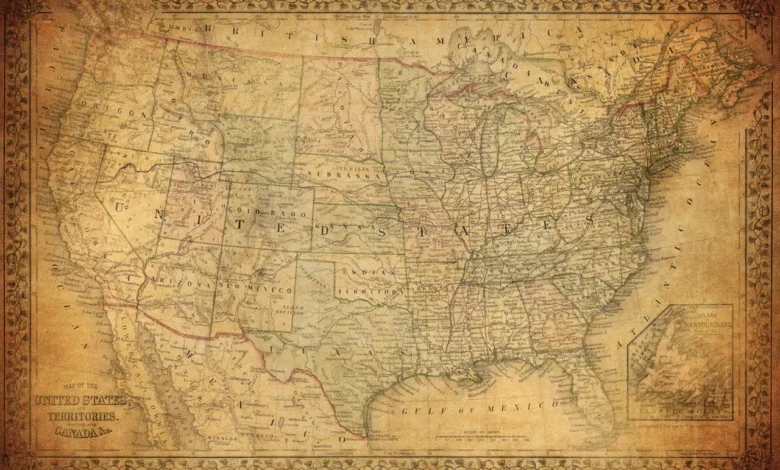
Thousands of words deeply embedded in the everyday language of United States residents share a common root: Spanish. This is a legacy of the era when the Spanish Empire spent over three centuries actively exploring, mapping, and settling vast regions that today belong to the U.S. The influence of that period is forever etched into the country’s geography, visible everywhere—from modern maps and road signs to the founding documents of cities, counties, and even entire states.
The first Spanish-language name permanently inscribed in the history of what is now U.S. territory was “Florida.” This region remains, to this day, one of the most saturated with Spanish toponyms in the entire country. According to experts observing the development of Spanish language and culture in the U.S., every single American state boasts at least one municipality whose name is, in one way or another, linked to its Spanish past.
So how did it all start for Florida? In 1513, the Spanish explorer and conquistador Juan Ponce de León landed on these shores. His arrival coincided with the celebration of Pascua Florida—a Christian spring festival symbolizing the rebirth of nature. The native of Valladolid was so struck by the lush vegetation and blossoming landscape that he immediately named the new land “La Florida.” Thanks to this decision, today 8.5% of the state’s municipalities have Spanish-origin names.
The influence of the Spanish Empire on American maps runs much deeper than one might imagine. It’s not limited to religious names like San Agustin in St. Johns County, Florida, or Santa Rosa in California. There are also frequent references to geographic features, such as ‘Sierra,’ or to the names of historical figures, as in the case of Hernando de Soto.
It was this explorer and conquistador from Extremadura who led a landmark expedition to the southeast of what is now the United States. During this journey, in 1541, he discovered the Mississippi River, earning him widespread recognition. He is known not only as the conqueror of three Americas—having traveled thousands of kilometers across Central America, Peru, and North America—but also as the namesake of two counties in Florida. DeSoto County was established in 1836, and Hernando County, now home to more than 200,000 people, appeared on maps in 1843.
But these are by no means the only tributes to the Spanish pioneer. In various states, you can find the Hernando de Soto Bridge, DeSoto State Park in Alabama, DeSoto Falls in Georgia, and once again in Florida—the Fort De Soto Park. His image even adorned the reverse side of $500 banknotes in the early 20th century. And while his legacy, like that of many conquistadors of his era, remains controversial, his name still appears in official documents, on memorial plaques, in addresses, and on routes.
Many of these Spanish names appeared on American soil not only thanks to explorers and conquistadors. Missionaries and even cartographers also contributed. For example, Florida’s longest river, St. Johns, was originally named Río San Juan by the Spanish. The same applies to Matanzas Bay and the river of the same name, which connects two ocean entrances: one near the port city of St. Augustine, and the other directly at the Fort Matanzas National Monument, another Spanish bastion built in Florida in 1740 to protect the city.
And Florida is not alone in this. In half of all U.S. states, there is at least one county with a name rooted in the Spanish language or history. The most prominent examples are New Mexico, California, and Arizona, where the Spanish legacy is particularly strong.