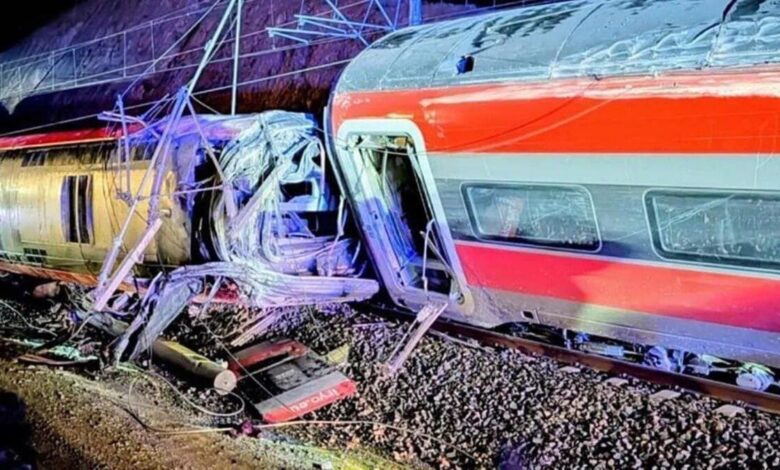
A Sunday evening in the province of Córdoba turned into a tragedy Spain will remember for years. Two high-speed trains collided on a railway section near Adamuz—one belonging to Iryo, the other to Renfe. The death toll has reached 39, with over a hundred injured. Among the victims are children, and many are in critical condition. Seventy-three people remain hospitalized, 24 of them fighting for their lives.
Families of passengers whose loved ones are still missing are desperately searching for any information. Social networks are flooded with photos and pleas for help: people post pictures of their relatives, hoping someone will recognize them among the survivors or provide any news at all. These messages are filled with panic, fear, and hope, all mixed together. The hotlines set up by Renfe and Iryo have not stopped ringing for a minute.
Timeline of the disaster
It happened in a matter of seconds. The Iryo train, which had departed from Málaga heading toward Madrid’s Puerta de Atocha station, was carrying 317 people on board. At 19:39, the last three carriages derailed and crashed onto the adjacent track. At that moment, an Alvia Renfe train was traveling on that line towards Huelva. The collision was unavoidable: the Iryo carriages struck the first two coaches of the Alvia, which, from the impact, were thrown off a four-meter embankment.
As a result of the collision, both trains were scattered across the embankment and railway tracks. The scene was one of mangled carriages, belongings strewn about, the screams of the injured, and utter chaos. Rescuers and medics arrived almost instantly, but the scale of the disaster was so immense that even the most seasoned emergency workers were visibly shaken.
Response and Investigation
Minister of Transport Óscar Puente described the incident as “incredibly strange”—the crash happened on a straight section of track that had just been repaired, and both trains were virtually new. He noted that the investigation may take a month, as experts have yet to find a logical explanation for what happened. Specialists are baffled: how could something like this occur on a modernized line with state-of-the-art trains?
Iryo stated that their train had undergone a technical inspection just four days prior and was built in 2022. Representatives from Renfe and Iryo remain in constant contact with authorities and have pledged full cooperation with the investigation. The infrastructure owner, Adif, expressed condolences and wished a speedy recovery to the injured.
Aid for the Victims
The mass casualty protocol has been activated in Córdoba: identification of the victims is underway at the Institute of Forensic Medicine. The evacuation of passengers was completed only late at night. All the injured have been taken to hospitals in Córdoba, Sevilla, and Madrid. The Renfe president, Álvaro Fernández Heredia, has publicly expressed condolences to the families of the deceased and the injured.
The head of the Andalusian government, Juanma Moreno, reported that 75 people remain hospitalized, 15 of them in critical condition. According to him, the death toll may still rise. The 112 Andalucía emergency service has asked passengers to report their status via social networks to avoid overloading phone lines.
Consequences and unanswered questions
High-speed rail traffic between Madrid and Andalusia is completely suspended. Authorities and railway companies are working to restore service, but no timeline has been given yet. Prime Minister Pedro Sánchez noted the coordinated efforts of emergency services and offered condolences to the families of the victims.
The tragedy in Adamuz has sparked a wave of sympathy across the country and beyond. European leaders have sent messages of support to Spain. But the main question remains: how could such a disaster occur on one of the most modern railways in Europe? There is still no answer, and this uncertainty is even more worrying than the accident itself.