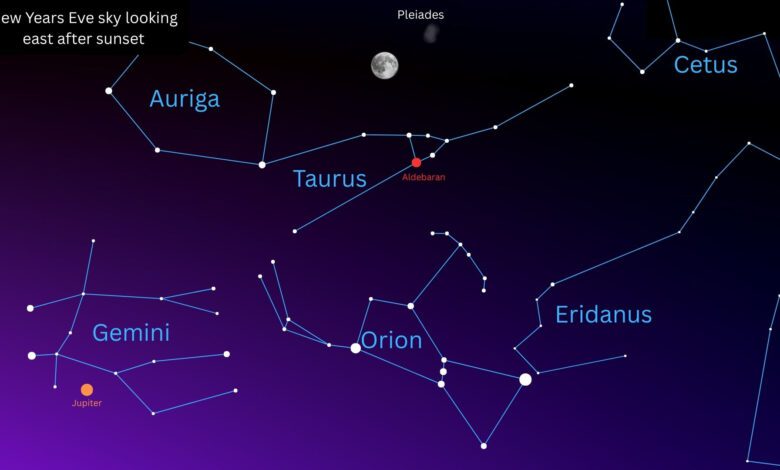
On the night of December 31, 2025, to January 1, residents of Spain will witness a rare combination of astronomical phenomena. While festive fireworks light up the streets, it’s worth looking up at the sky, where a true natural light show will unfold. That evening, the Moon—waxing and nearly full—will shine in the constellation Taurus, accompanied by the famous cluster Pleiades nearby. Only about five degrees—roughly the width of three fingers at arm’s length—will separate them. The bright lunar disk, illuminated at 95%, will become the main highlight of the eastern horizon just after sunset.
Just below the Moon, closer to the horizon line, the stars of the constellation Orion will twinkle. Their shimmering is easy to spot even with the naked eye. If you look left of Orion, you’ll see a particularly bright point—not a star, but Jupiter, which this night will be in the constellation Gemini, near its two brightest stars, Castor and Pollux.
Planet parade
Saturn will also command attention. Its steady light can be seen in the southern sky, about halfway up from the horizon. Those with a telescope with an aperture of at least 6 inches will get the chance to observe Saturn’s famous rings. This year, they’re seen almost edge-on, but by 2026 they will gradually open up, revealing their magnificent structure and the famous Cassini Division, which spans nearly 4,800 kilometers.
By midnight, Saturn will disappear below the horizon, giving way to the Moon and Jupiter, which will rise high overhead. At this time, it’s worth turning your attention to the northern sky: about 40 degrees above the horizon—equal to the width of four clenched fists—you can spot Polaris, the North Star. To its right lies Ursa Major, which on this night will appear almost vertical, as if standing on the tip of its handle.
Stargazing routes
As the clock counts down the final minutes of the year, the stars will continue their steady journey across the sky. With the arrival of the new year, the Moon, Jupiter, and bright stars will keep lighting up the night, inviting everyone to observe. For those new to astronomy, this is a great opportunity to get started: simply find a spot away from city lights and bring binoculars or a telescope.
Experts recommend reviewing a star chart in advance so you don’t miss the most interesting sights. Pay special attention to the Pleiades—this is one of the most beautiful and easily recognizable star clusters, which will be very close to the Moon on New Year’s night. And if the weather is clear, you might even spot faint stars usually hidden by city glare.
Tips for stargazers
If you plan to celebrate New Year’s Eve outdoors, make sure to dress warmly and bring hot drinks. Winter nights in Spain can be chilly, especially away from the cities. Don’t forget a flashlight with a red filter—it will help you read maps and won’t spoil your night vision.
If you’re just getting into astronomy, take note of advice from experienced observers. They suggest starting with bright objects—the Moon, Jupiter, and Saturn—then moving on to more challenging targets like the Pleiades or the stars of Orion. For those looking to upgrade their gear, there are great deals on telescopes and binoculars to make observing even more exciting.
Let New Year’s Eve 2025 mark the beginning of amazing discoveries and inspire you to new astronomical adventures. Clear skies and Happy New Year!
By the way, Space.com is one of the world’s leading resources dedicated to astronomy and space. The website, founded in 1999, regularly publishes news, reviews, and advice for enthusiasts and professionals alike. The Space.com team includes experienced journalists, astronomers, and science reporters who keep up with the latest discoveries and share unique insights about the Universe. Thanks to their work, millions around the globe learn about the brightest events in the night sky and find inspiration for their own stargazing.