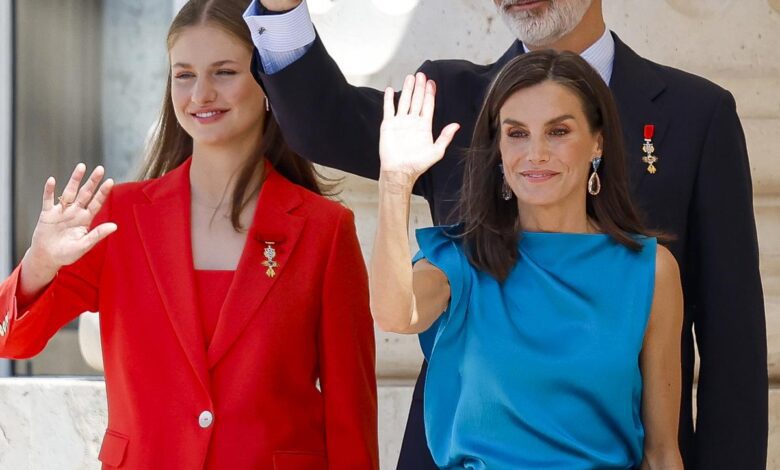
Just two days, but an intense schedule. King Felipe, Queen Letizia, and Princess Leonor arrived in Navarra with an agenda more reminiscent of a marathon: five cities and seven official events. This visit serves two important purposes. First, to strengthen the Crown’s position in this autonomous community, and second, to officially present the heir as Princess of Viana. Although she has held this title since her father ascended the throne in 2014, this is the trio’s first joint visit to Pamplona in her new status. It’s worth noting that since then, Leonor, no longer an infanta, has acquired several historic titles: Princess of Asturias, Girona, and Viana, as well as Duchess of Montblanc, Countess of Cervera, and Lady of Balaguer. The royal procession will pass through key sites in the region—Pamplona, Viana, Yesa, Olite, and Tudela—promising an immersion in history through visits to palaces, monasteries, and ancient ruins.
However, behind the official ceremonies lies another, equally important story. This trip to Navarra will serve as a baptism by fire for Queen Letizia’s newly formed team. Marta Carazo, who now heads her secretariat, and Rosa Lertxundi, the new head of the Royal Household’s communications department, are traveling with the monarchs around the country for the first time. For them, it is a kind of first true field test. The stakes are especially high for Rosa Lertxundi: her challenge is to radically reshape the media strategy, leveraging Princess Leonor’s popularity to boost audience engagement and viral reach on social media. There is a sense of intrigue in the air: will we see higher quality and more diverse audiovisual content? Will it include not only official moments but also more personal, candid scenes of mother and daughter interacting? And perhaps the main question on many minds: will we finally get to hear their spontaneous conversations with people at the barriers, not just their carefully prepared speeches?
In addition to the anticipated changes in the Palace’s information policy, the visit also prompts other reflections. Will the arrival of Marta Carasso on the Queen’s team impact Letizia’s public image or alter the usual choreography of such official outings? This trip may not provide a definite answer, as the presence of King Felipe shifts the decision-making center to a higher hierarchical level, with the head of the Royal Household, Camilo Villarino, playing a key role. Another interesting question concerns the status of the Princess of Viana title itself. Can it become as significant as the Princess of Asturias and Princess of Girona titles? For now, this seems unlikely. The latter two are backed by major foundations that award prestigious prizes. In Navarre, there was a “Prince of Viana” cultural prize until 2015, but local authorities later decided to dissociate it from the Crown.
Leonor herself bears a name deeply tied to the history of Navarra—it belonged to the fourth daughter of Queen Blanca and Juan II, who ruled the kingdom for over twenty years. Naturally, drawing direct parallels between the fate of a medieval ruler and Spain’s future queen—who is currently studying at the Air Force Academy in San Javier—would not be accurate. Clearly, Princess Leonor’s presence, out of military uniform, adds a special interest to this extraordinary trip, which also falls on a weekend. We see how the Zarzuela Palace must perform a balancing act to fit official visits into the heiress’s busy academic schedule. This autumn is expected to be particularly demanding for her—next month she faces another working weekend at the Princess of Asturias Awards ceremony.