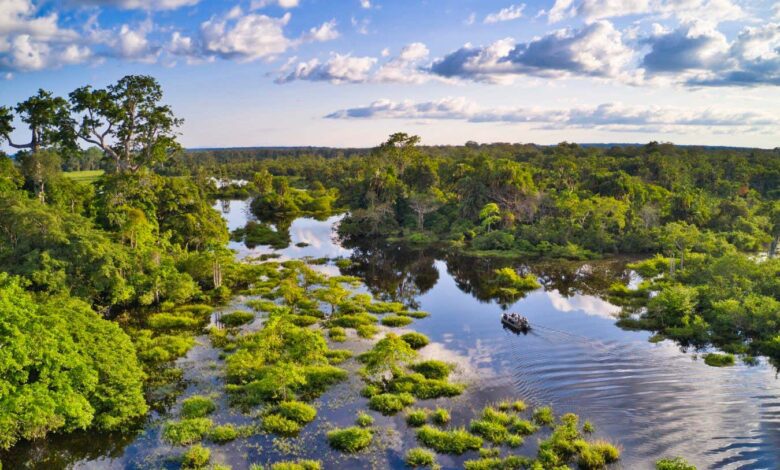
In recent years, African tropical forests—once considered a major natural barrier against global warming—have lost their status as a ‘carbon sink.’ A new study by British scientists has found that these ecosystems are now emitting more carbon dioxide into the atmosphere than they can absorb. This turn of events is causing serious concern among climate and environmental experts.
Until recently, Africa’s forests and shrublands accounted for up to one-fifth of the total CO₂ removed from the atmosphere by plants worldwide. The tropical forest of the Congo Basin played a particularly crucial role, absorbing hundreds of millions of tons of greenhouse gases each year. However, the situation has changed: over the past decade, rates of deforestation and forest degradation have risen sharply, as have emissions.
From 2007 to 2010, African forests were increasing their biomass, which enabled them to effectively sequester carbon. But between 2011 and 2017, scientists recorded the loss of more than 100 million tons of biomass. This is equivalent to annual emissions of about 200 million tons of CO₂. The main causes are intensive logging, agricultural expansion, and mining.
How losses are measured: satellites and ground observations
To assess changes in the forests, specialists used satellite data, analyzing the color, moisture, and canopy height at various locations across the continent. This information was compared with ground-based measurements, although such data remain scarce in Africa. This approach provided a more accurate picture of what is happening, but it is not without limitations.
According to Professor Heiko Balzter of the University of Leicester, tropical forests remain one of the key tools in combating climate change. However, if they stop fulfilling their function, humanity will have to reduce emissions from burning oil, gas, and coal even faster in order to achieve climate targets.
At the same time, Simon Lewis of University College London notes that satellite methods do not allow scientists to distinguish tree species or accurately assess how much carbon is actually stored by forests with high biomass. Moreover, these technologies do not provide a complete picture of emissions related to deforestation.
Peatlands and hidden carbon reserves
The study did not address another important aspect—peatlands located beneath parts of the Congo Basin forests. These unique ecosystems absorb a small amount of CO₂ each year, but they hold about 30 billion tons of ancient carbon. If the peatlands are destroyed, a huge amount of greenhouse gases could be released into the atmosphere, worsening the climate crisis.
Scientists emphasize that although deforestation is increasing in the Democratic Republic of the Congo, it remains unclear how much this affects the overall emission balance across the continent. However, the trend is evident—Africa’s forests are no longer coping with the previous level of pressure.
Global consequences and new challenges
The loss of Africa’s forests’ ability to absorb carbon dioxide could accelerate global warming. Environmentalists warn that unless urgent measures are taken to preserve and restore tropical ecosystems, the consequences for the climate will be irreversible. Local communities that depend on forests, as well as the region’s biodiversity, are the first to suffer.
The international community is being urged to tighten controls on deforestation, implement sustainable land management, and support forest restoration programs. Only a comprehensive approach will preserve Africa’s unique natural resources and stabilize the climate situation.
In case you didn’t know, Professor Heiko Baltzer is one of the leading experts in remote sensing and the ecology of tropical forests. He heads research projects at the University of Leicester and is actively involved in international climate initiatives. His work focuses on analyzing ecosystem changes and finding solutions to maintain the planet’s natural balance.