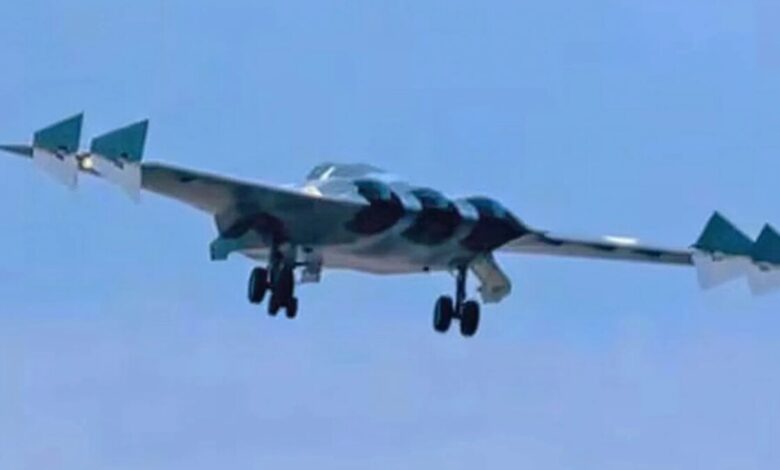
New photos of the second prototype of China’s advanced J-36 fighter jet, developed by Chengdu Aircraft, have surfaced online. The latest images clearly show significant differences from the first version, which was unveiled in late 2024. Experts have paid particular attention to the unusual nozzles shaped as three flat elements, which can change the direction of thrust.
Technological transformation: What’s new in the J-36
Unlike the earlier version with recessed, trough-shaped nozzles, the new modification features a set of three flat nozzles reminiscent of those used on the American F-22 Raptor. This system allows for thrust vectoring, greatly expanding the aircraft’s maneuverability. Chinese engineers have been experimenting with such technologies for several years, but their appearance on the J-36 came as a surprise even to experts.
In addition to the new nozzles, the photos reveal redesigned air intakes and upgraded landing gear struts. These improvements indicate that the J-36 project is undergoing active development and testing, with engineers still searching for optimal solutions to boost the aircraft’s combat capabilities.
Impact of thrust vectoring on performance
The thrust vector control system significantly enhances the fighter’s maneuverability at all speeds and altitudes. This is especially important for aircraft with unconventional aerodynamic designs, such as the J-36, which features a tailless configuration. With the new nozzles, pilots will be able to perform complex aerobatic maneuvers and maintain stability even in extreme conditions.
However, implementing such technology inevitably increases weight and complicates the aircraft’s design. For a heavy tactical aircraft like the J-36, these drawbacks are less critical than for lighter models. Nevertheless, experts note that these changes could affect the fighter’s stealth, especially when observed from the rear hemisphere.
Stealth trade-offs and new capabilities
Switching from embedded nozzles to flat ones with thrust vector control will likely lead to a slight reduction in stealth effectiveness. However, the developers have prioritized improved maneuverability and handling, which could prove more crucial for combat operations at high altitudes and in challenging air combat scenarios.
Experts believe this decision indicates a shift in priorities within Chinese military aviation. Previously, the focus was mainly on reducing visibility, but now the ability to engage in maneuverable combat and effectively counter modern threats is coming to the fore.
Comparison with foreign counterparts and future prospects
The integration of thrust vector control on the J-36 brings it closer to leading aircraft such as the American F-22 Raptor and the Russian Su-57. Chinese engineers are aiming not just to catch up with, but to surpass, their competitors by introducing their own innovative solutions. In the coming years, we can expect new J-36 modifications with even more advanced control systems and weaponry.
It is still unknown when the J-36 will officially enter service with the People’s Liberation Army of China, but it is already clear that this project will be among the most significant for the nation’s aviation industry. Attention to detail and the drive for technological leadership allow China to confidently advance in the field of military development.
Background: What is known about Chengdu Aircraft and the J-36 project
In case you didn’t know, Chengdu Aircraft Industry Group (成都飞机工业集团) is one of the largest aerospace manufacturers in China. Founded in 1958, it is part of the state-owned AVIC corporation and specializes in the development and production of both military and civilian aircraft. The company’s most famous projects are the J-10 and J-20 fighter jets, which are already in service with the Chinese Air Force. The J-36 is Chengdu Aircraft’s latest development, classified as a sixth-generation combat aircraft. The J-36 project is positioned as a heavy tactical fighter featuring advanced stealth technologies, artificial intelligence, and integrated weapons systems. In recent years, the company has actively invested in research and development, aiming to elevate Chinese aviation to a new level. Chengdu Aircraft collaborates closely with leading national research institutes and participates in international exhibitions to showcase its achievements. With government support and extensive experience in developing complex aerospace systems, the company holds a leading position in the Asian region. The J-36 is seen as a response to modern challenges in military aviation and stands as a symbol of China’s technological progress. In the coming years, new prototypes are expected to emerge, and the testing program will expand, further strengthening China’s position in the global arms market.