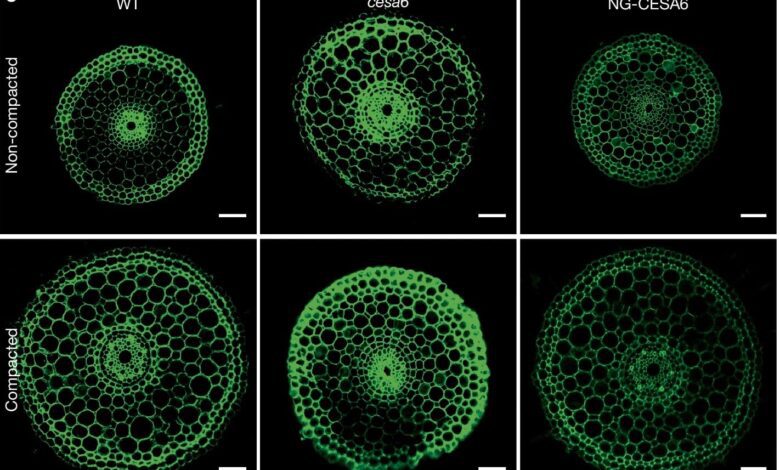
The root systems of plants face serious challenges when the soil becomes too compacted by heavy machinery. In such conditions, roots cannot grow downward freely, which directly affects crop yields. Until recently, it was only known that in compacted soil, roots stop elongating and begin to thicken, triggered by ethylene—a gas that accumulates around the root tip due to poor ventilation. However, exactly how this gas affects root structure at the cellular level remained a mystery.
A team of researchers set out to investigate this issue and conducted a series of experiments with rice. They created special mutant plant lines in which the genes responsible for cellulose synthesis and hormonal response were altered. To observe root growth in soils of varying density, they used X-ray computed tomography, and to measure cell wall stiffness and thickness, they employed atomic force microscopy.
Genetic adaptation
During the study, scientists discovered that the protein OsARF1 plays a key role in helping roots adapt to dense soil. Under the influence of ethylene, this protein is activated and begins to suppress the genes responsible for cellulose synthesis (CESA). Interestingly, this process does not occur throughout the entire root, but only in the inner tissues—the cortex. As a result, the walls of the inner cells become thinner and more elastic, allowing the root to expand in width. Meanwhile, the outer cell layer, the epidermis, remains thick and rigid, unaffected by these changes.
This combination—an elastic core with a robust outer shell—resembles the design of industrial pipes. Thanks to this structure, the root gains axial stability and can act like a wedge, pushing apart soil particles and finding its way even through the densest layers of earth.
Engineering parallels
The researchers compared this biological mechanism to engineering principles used in pipe design. A rigid outer shell protects the root from deformation, while an expanding pressurized core provides the force needed to move forward. This “pipe effect” prevents the root from being squashed or bent, enabling it to push through physical barriers in the soil efficiently.
This active tissue modification mechanism allows plants not just to passively respond to adverse conditions, but to deliberately restructure themselves to overcome challenges. Understanding how the ‘ethylene — OsARF1 — cell wall’ chain functions opens up new possibilities for crop breeding.
Prospects for Agrotechnologies
The data obtained could serve as a foundation for developing new varieties of rice and other crops capable of effectively expanding their root systems even in fields where the soil is heavily compacted by machinery. This is especially relevant for modern agricultural technologies, where intensive use of heavy equipment is becoming the norm.
Breeders can now deliberately target genes responsible for cellulose synthesis and ethylene response to produce plants with improved ability to penetrate dense soil. This approach can boost crop yields and increase resilience to adverse conditions.
The Future of Research
Discovering the mechanism by which rice roots bore through compacted soil not only broadens our understanding of plant physiology, but also underscores the importance of interdisciplinary research. Combining biology, genetics, and engineering is enabling solutions that once seemed impossible.
Going forward, scientists plan to study how universal this mechanism is among other plant species and whether it can be used to improve the properties of various agricultural crops. It is quite possible that similar processes occur in other grains as well, opening new horizons for the global agricultural sector.
If you didn’t know, OsARF1 is not a company but the name of a protein that plays a key role in regulating root growth in rice. Its functions are being actively studied in leading laboratories around the world. Research in this area is supported by international scientific foundations and aims to enhance food security. Rice (Oryza sativa) is one of the most important crops for humanity, and any discoveries related to its resilience are of global significance.