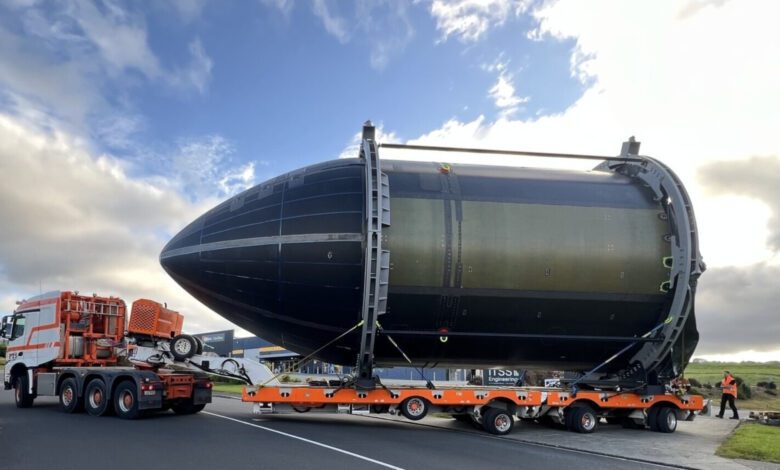
The American company Rocket Lab has completed a series of rigorous tests on a new fairing for its promising Neutron rocket, which is scheduled for its maiden flight early next year. The company’s engineers have developed an unusual structure, unofficially dubbed the Hungry Hippo—after the board game where hippo figures open their jaws wide. This design allows the fairing not only to protect the payload but also to open and close like a giant shell, making it reusable.
Unlike previous models where the fairing split into two halves and fell into the ocean, the new system ensures both halves remain connected and return to Earth with the first stage. This approach is aimed at lowering launch costs and speeding up rocket turnaround for subsequent missions. Rocket Lab expects this step will allow it to compete with market leaders, particularly Falcon 9 from SpaceX, which until now had been the only rocket with proven reusability in orbit.
Hungry Hippo has undergone a series of demanding tests at the company’s California test site. The design withstood 275,000 pounds of pressure, simulating the extreme forces of launch. The opening and closing mechanisms were tested at accelerated rates to ensure their reliability even under intense use. In addition, engineers checked the integration of the software and tested the structure’s strength at 125% above the calculated requirements.
Technology and competition
Neutron is not just a new rocket, but Rocket Lab’s bid to enter the medium and heavy launch market, an area previously dominated by SpaceX. Unlike its predecessor Electron, designed for small satellites and mainly used for commercial and scientific missions, Neutron will be able to deliver up to 13 tons of payload to low Earth orbit. This opens up new opportunities for the company and allows it to attract customers who previously had to turn to larger providers.
Special attention is given to materials: Neutron is positioned as the world’s largest rocket made from carbon composite. This not only reduces structural mass but also increases strength, which is critical for reusability. According to Rocket Lab’s Vice President of the Neutron project, Shaun D’Mello, the company aims not just to build another rocket, but to change the game in the launch market by offering innovation at an affordable price and on an accelerated timeline.
Preparing for launch
After all tests were completed, the fairing was sent to the launch site in Virginia (Mid-Atlantic Regional Spaceport), where it will be integrated with the rocket’s first stage. In the coming months, engineers will conduct a series of pre-launch checks, including static fire tests of the nine Archimedes engines that will provide thrust for the reusable booster. Neutron will stand 43 meters tall with a diameter of 7 meters, making it one of the largest rockets in its class.
Rocket Lab emphasizes that no other company has previously implemented a system with a fully closing payload fairing that returns together with the first stage. This solution is expected not only to improve mission reliability, but also to significantly reduce the costs of preparing for subsequent launches. In a market with growing competition for space services, such innovations are becoming a key factor for success.
The Future of Launches
The first Neutron flight is expected as early as the beginning of next year. Successful implementation of the project could shift the balance of power in the industry and provide fresh momentum for reusable technologies. Rocket Lab has already attracted interest from major clients, including both government and private sectors, seeking reliable and cost-effective ways to launch payloads into orbit.
In the near future, the company plans to complete all necessary checks and begin the final assembly of the rocket. If tests go well, Neutron will become the world’s first rocket with such a recoverable fairing system—a potential new industry standard.
For reference, Rocket Lab is a private aerospace company founded in 2006 in New Zealand, with its headquarters in the US since 2013. The founder and CEO is Peter Beck. The company is known for its innovative small and medium-sized launch vehicles, as well as the development of its own engines and control systems. In recent years, Rocket Lab has carried out dozens of successful launches and has established itself as one of the most dynamic players in the global space services market.