An innovative approach to reducing energy consumption
Russian researchers have developed a new strategy that significantly lowers the laser power required to trigger optical parametric oscillations in microresonators. These miniature ring-shaped chip devices play a crucial role in modern quantum technologies and are used to create compact computing systems and energy-efficient quantum computers.
Microresonators are tiny optical storage devices made from silicon or other materials. They can accumulate light and alter its properties through nonlinear effects. Of particular interest are resonators capable of changing emission parameters, opening up new possibilities for photonic computing.
A team from the Russian Quantum Center, MIPT, P. N. Lebedev Physical Institute of the RAS, and Moscow State University conducted a comprehensive study of integrated ring microresonators. Their goal was to examine the conditions under which such systems generate degenerate optical parametric oscillations—a process that produces new radiation with unique phase properties.
Bichromatic pumping and phase bistability
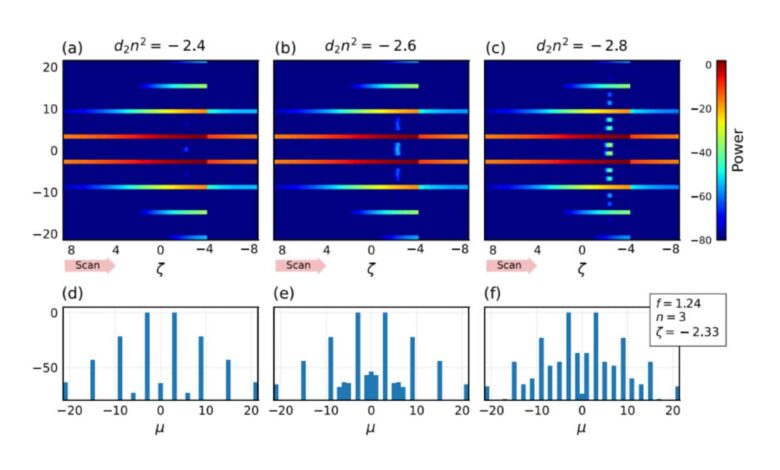
In their research, scientists used a bichromatic pumping technique, applying two lasers with different wavelengths to the resonator. This approach enabled the emergence of non-classical light states in the system at low power, and when a certain threshold was exceeded, the formation of a parametric signal with two stable phase states. These effects are crucial for coherent Ising machines and squeezed light generators, both of which are increasingly used in quantum computing and photonic technologies.
The main challenge lay in achieving the high power needed to generate the desired phase states. This led to significant thermal effects and increased the devices’ energy consumption. To overcome this barrier, the researchers focused on finding optimal conditions to minimize the energy required to initiate the signal mode.
As a result of their analysis, the team determined that optimizing mode shifting and resonator geometry can more than halve the power threshold. This effect is achieved by synchronizing phases between different modes inside the microresonator, which enhances generation efficiency and reduces the impact of competing nonlinear processes.
Multimode analysis and dispersion engineering
To verify their findings, the team conducted numerical simulations using coupled-mode equations, taking into account dispersion and asymmetry effects in the system. They demonstrated that shifting the central mode using photonic molecules—interconnected resonators—reduces the threshold by 50%. Moreover, symmetrically shifting the side modes further lowers the required power by 40%.
The multimode analysis showed that the system remains stable even when power is unevenly distributed between the two lasers. The permissible deviation reached two percent, ten times higher than the standard threshold for stable generation. This greatly simplifies equipment tuning and microresonator integration into compact devices.
The researchers note that their approach opens up new prospects for creating energy-efficient quantum devices that can operate outside laboratory settings. This methodology could serve as a foundation for developing new generations of photonic and quantum computing systems.
Future plans and ongoing research
The team’s immediate plans include studying the role of the backward wave in forming a signal with two stable phase states, as well as conducting experiments to validate their theoretical calculations. In addition, the researchers intend to explore frequency-pulling regimes that could further increase the stability and efficiency of microresonators.
Further development of this technology is expected to enable the creation of even more compact and cost-effective quantum devices capable of operating in real-world conditions. The discovery by Russian physicists could become an important step toward the widespread adoption of quantum technologies in everyday life.