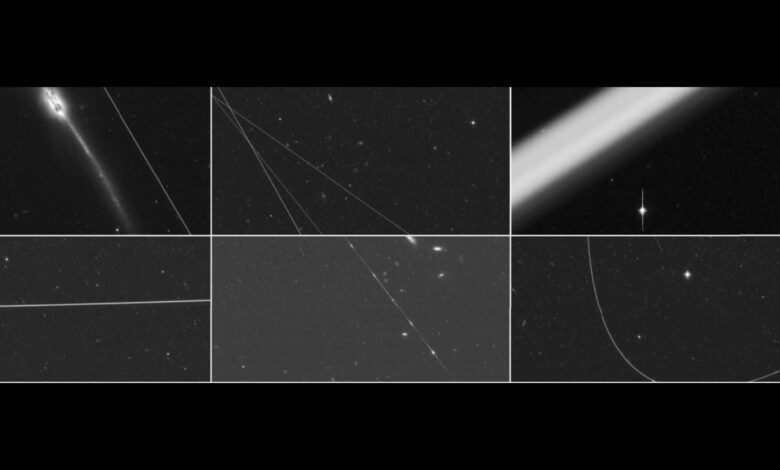
In recent years, Earth’s orbit has rapidly filled with thousands of new satellites, and this trend is already creating more than just inconveniences for ground-based observatories. Now, the reflected light from these satellites increasingly interferes even with space telescopes, raising serious concerns within the scientific community. Experts estimate there are currently around 15,000 satellites orbiting the planet, with more than half belonging to the Starlink constellation deployed by SpaceX. This network alone accounts for over 9,000 satellites, and the number continues to grow.
In 2023, astronomers recorded for the first time that satellites had started appearing in images captured by the renowned Hubble telescope. Bright streaks caused by sunlight reflecting off satellites can not only distort images but completely obscure or even mimic real celestial objects. This threatens the reliability of scientific data and complicates analysis of the images.
If all the satellite constellation projects already submitted to international organizations are implemented, by the end of the 2030s Earth could be surrounded by up to half a million satellites. Scientists have modeled how such a scenario would affect the operation of four space telescopes: the currently active Hubble and SPHEREx (Spectro-Photometer for the History of the Universe, Epoch of Reionization and Ices Explorer), as well as the upcoming Chinese Xuntian and the European ARRAKIHS mission, both scheduled to launch in the coming years.
The rise in the number of satellites
The modeling used orbital data from all registered satellite constellations. Researchers examined various scenarios—ranging from a hundred to a million satellites in orbit. The results showed that with current plans (about 560,000 satellites), every third Hubble image will contain at least one satellite trail. For SPHEREx, ARRAKIHS, and Xuntian, the outlook is even worse: more than 96% of exposures will be spoiled by satellite streaks. If the number of satellites reaches one million, the level of image contamination will nearly double.
Current image processing methods are unable to fully recover lost scientific information. Even if the bright streaks are masked, it is impossible to reconstruct the original signal hidden beneath them. This means that some data will be irretrievably lost, and certain discoveries may never be made.
Problems and Solutions
The authors of the study note that the pace of satellite launches is outstripping efforts to assess their impact on the environment and science. One proposed measure is to position large satellite constellations below the orbits of space telescopes. In this case, the satellites would spend more time in Earth’s shadow and shine less brightly. However, this approach could increase the number of satellites burning up in the atmosphere and does not fundamentally solve the problem.
The lead author of the study describes himself as an “optimistic pessimist” and expresses hope that effective measures can be implemented before the worst-case scenario unfolds. He emphasizes that urgent discussions between scientists, industry, and regulators are essential to preserve the future of scientific research. Only through joint efforts can we ensure that orbital space remains suitable for observation and technological advancement.
The Future of Astronomy
The question of how to balance the interests of commercial companies and the scientific community remains unresolved. On the one hand, satellite networks provide internet access to the most remote corners of the planet; on the other, they could permanently close humanity’s window to the universe. Astronomers are calling for the development of international standards and regulations to minimize harm to fundamental research.
For now, new satellites continue to launch, and the number of streaks in space telescope images keeps growing. In the coming years, the situation could become critical if steps are not taken to regulate orbital space. What’s at stake is humanity’s ability to study the cosmos and make new discoveries.
Incidentally, SpaceX, which owns the largest Starlink satellite constellation, was founded by Elon Musk in 2002. In recent years, the company has become a leader in commercial space launches and is actively developing projects to provide global internet access. Starlink is a network of low-Earth orbit satellites designed to transmit data worldwide. The company plans to further expand its constellation, which has raised concerns among astronomers and environmentalists.