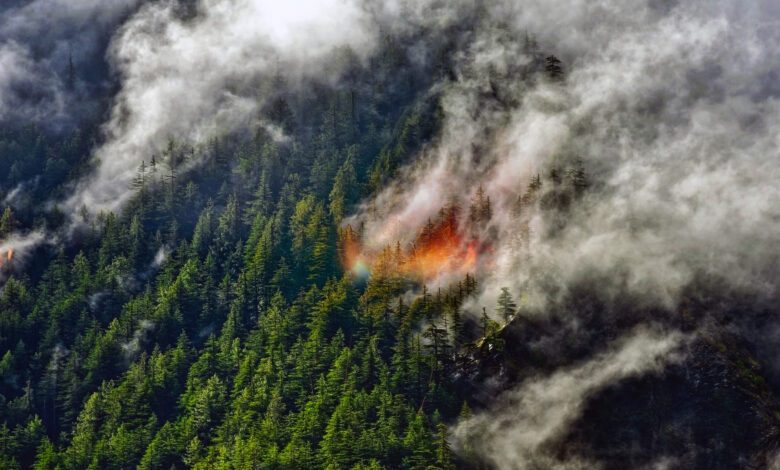
Wildfires are not only capable of destroying vast areas, but also of creating unique weather phenomena. In some cases, the intensity of the fire is so great that special clouds form—pyrocumulonimbus storms—that carry smoke up to 16 kilometers high. Until recently, scientists could only speculate about how this smoke affects the climate, since collecting samples at such altitudes was nearly impossible.
However, in June 2022, a team of researchers from the Harvard John A. Paulson School of Engineering and Applied Sciences carried out a unique experiment. Using NASA’s ER-2 aircraft, they penetrated a fresh smoke plume formed after a major fire in New Mexico. At an altitude of about 14.5 kilometers, the specialists detected unusually large aerosol particles that had not been previously accounted for in climate models.
It turned out these particles are about twice as large as those usually found in the lower layers of the atmosphere. This effect is explained by the fact that in the upper atmosphere, air mixes very slowly, allowing smoke particles to remain together longer, collide, and merge to form larger structures. This discovery marks a major breakthrough in understanding the processes that occur in the atmosphere after large-scale fires.
An unexpected effect
During the experiment, scientists discovered that large smoke particles can significantly increase the amount of reflected radiation escaping back into space. According to their calculations, this figure rose by 30–36% compared to aerosols found at lower altitudes. This effect leads to a noticeable cooling of the atmosphere, which had not been accounted for in most climate models until now.
Until now, it was believed that wildfire smoke mainly contributed to warming, since fine particles absorb sunlight. However, new data show that at higher altitudes the situation changes: larger particles reflect more energy than they absorb, thereby cooling the atmosphere. This discovery could significantly revise climate change forecasts, especially in regions where wildfires are becoming increasingly frequent and intense.
Impact on the atmosphere
In addition to their cooling effect, scientists suggest that such large particles may also influence air circulation in the atmosphere. According to one of the study’s authors, John Dykema, localized heating caused by smoke accumulation can shift jet streams and alter weather patterns. However, much more research will be needed to fully understand these processes.
Experts are not yet ready to draw definitive conclusions about exactly how the climate will change under the influence of high-rising smoke. However, it is already clear that conventional models need to be revised, and new data could hold the key to more accurate predictions of weather and climate changes.
The future of research
The discovery of large aerosols in the upper atmosphere opens up new frontiers for science. Researchers now face the task of determining how long such particles can remain aloft, how they interact with other atmospheric components, and the extent of their impact on global climate processes.
In the coming years, additional flights and experiments are planned to collect more data on the composition and behavior of wildfire smoke. These studies will not only deepen our understanding of the consequences of natural disasters, but also help develop more effective measures to protect the climate and prevent extreme weather events.
If you didn’t know, the Harvard John A. Paulson School of Engineering and Applied Sciences is one of the world’s leading research centers specializing in ecology, climate, and emerging technologies. Unique experiments are regularly conducted within its walls, producing results that reshape our understanding of processes on our planet. Participation in international projects and collaboration with NASA give scientists access to the most advanced tools and technologies for studying Earth’s atmosphere.