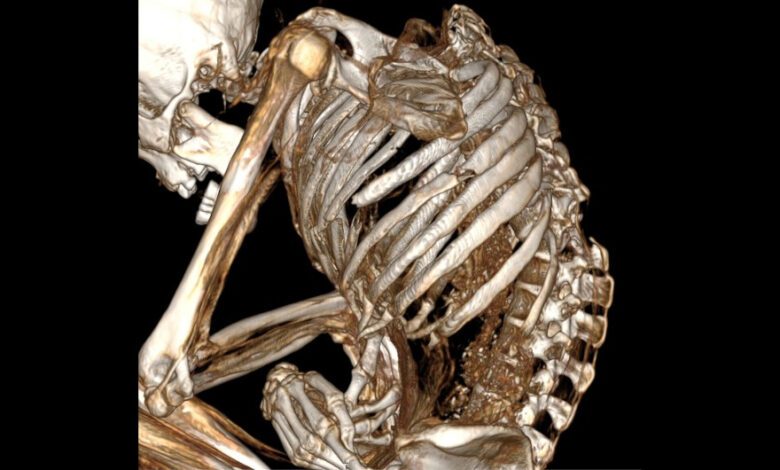
In Chile’s Atacama Desert, archaeologists have once again surprised the scientific community: the remains of a man found at the ancient Las Turquesas turquoise site have undergone thorough analysis using modern technology. Research conducted by paleopathologists has provided an unprecedented glimpse into the past, allowing scientists to reconstruct the circumstances of the death of a man who lived here about a thousand years ago. CT scans revealed numerous severe injuries that left him with no chance of survival.
Experts estimate that the man was of short stature—about 162–163 centimeters tall—and lived between 25 and 40 years. Radiocarbon dating places his death between 894 and 1016 AD. Alongside his mummified body, archaeologists found clothing, textiles, a bow with arrows, leather pouches with ore fragments, beads, and a snuffbox. These items suggest that the deceased was not just a local resident, but likely a miner or artisan involved in mineral extraction.
Archaeological discoveries
The Atacama Desert has long been known as a treasure trove of archaeological mysteries. Local peoples mined valuable minerals here for thousands of years, and this region contains some of the oldest evidence of mining activity in South America. However, discoveries of human remains directly linked to mining sites are extremely rare.
One of the most famous discoveries remains the mummy of a man who died in the Chuquicamata mine around fifteen hundred years ago. His remains were found as early as the late 19th century, and since then, scientists have repeatedly revisited the dangers faced by ancient miners. A new case from the outskirts of El Salvador only reinforces this: working in the mines was deadly—even for the most experienced workers.
Injuries and theories about the cause of death
A CT scan conducted by Catalina Morales and Francisco Garrido from the National Museum of Natural History in Santiago offered a detailed look at the nature of the injuries. The man’s spine was literally shattered—his vertebrae had shifted against each other, and multiple fractures to the ribs, both shoulder blades, the clavicle and the bones of the left leg pointed to a powerful blow to the left side of the body.
Experts are certain: all of the injuries occurred shortly before his death, since there are no signs of healing on the bones. Such trauma is typical in cases where a heavy object collapses on a person—whether from a rockfall in the mountains or a cave-in deep underground. Considering the burial findings, the theory of an accident during turquoise mining seems the most probable.
Ancient miners
Fatal mining accidents are not limited to South America. Similar incidents have been recorded, for example, in present-day Iran, where the remains of ancient miners were discovered in the Chehrabad mine. Some of these remains are so well-preserved that scientists have been able to study even the details of their clothing and textile dyeing techniques.
In Atacama, despite its rich history of mineral extraction, such finds remain rare. Each new discovery offers deeper insight into the risks faced by ancient residents of the region and the concerns that shaped their daily lives. Clothing, tools, and personal belongings found near the body become silent witnesses to the tragedies that unfolded deep within the mines.
Modern Methods
The use of CT scanning in archaeology has opened new horizons for the study of ancient remains. Scientists can now not only determine the age and sex of the deceased but also reconstruct the circumstances of their deaths with remarkable accuracy. In the case of the mummy from Las Turquesas, it was modern technology that revealed the cause of death: a powerful blow delivered by a heavy object—likely a stone slab.
Such research not only sheds light on individual tragedies of the past but also helps reconstruct the daily life and work of ancient peoples. Every new scan, every bone analysis, is another step toward understanding how the region’s history developed and the challenges its inhabitants faced.
If you didn’t know, the National Museum of Natural History in Santiago (Museo Nacional de Historia Natural) is one of the oldest scientific institutions in Latin America, founded in 1830. Its collection holds thousands of unique artifacts related to the history, archaeology, and nature of Chile. The museum is actively involved in international research and regularly uncovers new pages of the region’s past. Its exhibitions are open to the general public, and its scientific discoveries often make headlines in international media.