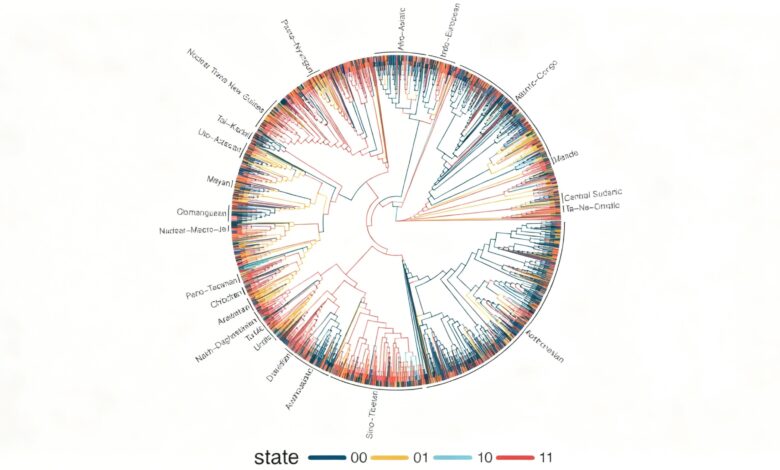
The results of an extensive study covering more than 1,700 languages are changing our understanding of how grammatical structures develop globally. For the first time, researchers have found convincing evidence that certain universal grammatical rules do exist and recur in unrelated languages. These findings became possible thanks to modern evolutionary analysis methods, which take into account not only geographical proximity but also the historical relationships between languages.
An international team of experts led by Annemarie Verkerk from Saarland University and Russell D. Gray from the Max Planck Institute for Evolutionary Anthropology analyzed 191 hypotheses regarding so-called ‘linguistic universals.’ They used the Grambank database—the world’s largest collection of data on grammatical features. According to the Max Planck Society, this approach revealed that about a third of these universals are supported by rigorous statistical analysis.
Statistics and Evolution
Previously, linguists tried to avoid the influence of similarities among related languages by selecting language groups that were as distant from each other as possible for analysis. However, this method could not completely eliminate hidden connections and often led to blurred results. The new study used Bayesian spatiophylogenetic methods that account for both the genealogy and geography of languages. This approach made it possible to trace how grammatical structures recur in different regions of the world, regardless of cultural and historical differences.
Particular attention was paid to word order and ways grammatical relations are expressed within a sentence. It turned out that certain patterns, such as the placement of the verb relative to the object or methods for marking syntactic connections, are found in languages with no common origin. This points to underlying constraints that shape the structure of human speech.
Boundaries of diversity
Despite the vast diversity of languages, the study showed that languages do not develop chaotically. On the contrary, they follow certain patterns that repeat time and again. According to RUSSPAIN.COM, these results offer a new perspective on how languages change and why certain grammatical solutions become more widely adopted than others.
The authors of the study note that their findings not only confirm the existence of universal grammatical patterns but also narrow the scope of questions for future research. Linguists can now focus on studying those universals that truly withstand rigorous testing and explore why these particular structures remain stable across different languages worldwide.
The pressure of thought and communication
The study also highlights the role of shared cognitive and communicative factors that shape languages. The recurrence of certain grammatical patterns is explained not only by history or geography, but also by universal features of human cognition. This opens new perspectives for understanding how people across the world structure their speech and convey information.
As a result of the researchers’ work, it has become clear: languages do not develop by chance, but under the influence of constraints and needs common to all people. This approach offers new insights into the evolution of languages and explains why certain grammatical solutions are found so widely.
Annemarie Verkerk is an evolutionary linguistics specialist renowned for her work on language change and linguistic universals. Her research combines statistical, phylogenetic, and linguistic methods to uncover patterns hidden beneath the surface diversity of languages. Her colleague Russell D. Gray is also a leading figure in the study of language evolution and the cognitive processes related to human speech development. Their joint projects have repeatedly laid the groundwork for new directions in global linguistics.