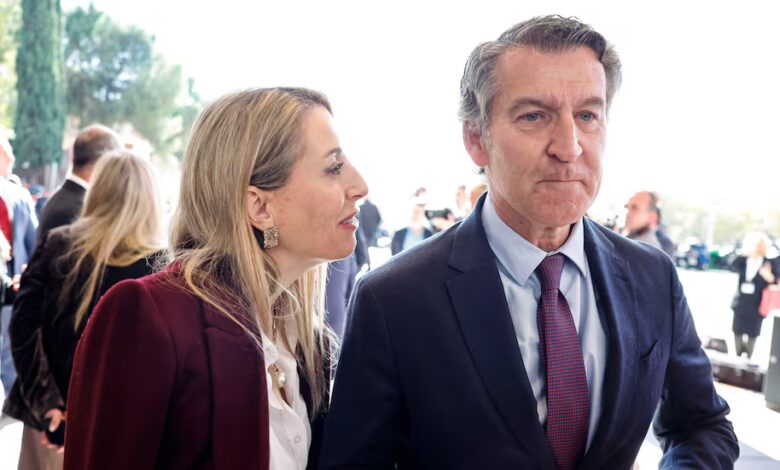
A tense election campaign has kicked off in Extremadura, with not only the presidency of the autonomous community at stake, but also the balance of power within Spain’s right-wing bloc. Alberto Núñez Feijóo has personally stepped in to support María Guardiola, the incumbent regional leader, aiming to prevent Vox from gaining decisive strength. The issue is not just whether the Partido Popular (PP) will win, but whether it can do so without relying on a coalition with the far-right.
All polls predict a confident PP victory, but the party falls short of an absolute majority. This means Guardiola will need either the support or at least the neutrality of Vox to form a government. Meanwhile, Santiago Abascal’s party is gaining ground: according to the latest data, their representation in parliament could double compared to the previous election.
Within the PP, officials admit the main goal is not just to win, but to ensure that Vox confines itself to abstaining in the vote for the new regional leader. Ideally, they hope to avoid concessions or forming a full coalition. They recall that even in 2011, when the PP achieved a record result, it still fell short of an absolute majority.
Vox’s growing influence
Latest forecasts indicate that Vox could win between 10 and 12 seats in the regional parliament—nearly double their previous representation. This makes the party a key player in any effort to secure a majority. The PP is expected to claim between 25 and 29 seats, but at least 33 are needed for a parliamentary majority. The Socialists (PSOE) risk falling to second place by a significant margin.
Internal PP sources admit: even if Guardiola achieves her best result, an absolute majority is almost unattainable for her. In 2011, when the party was led by José Antonio Monago, they had to rely on support from the left to win. Now, Guardiola can expect to receive around 38.5% of the vote—below the historical high.
In this situation, the PP is betting that Vox will simply abstain if the right holds more seats than all the left-wing parties combined. However, Vox representatives have already stated they intend to ‘raise the price’ for their support, citing the recent negotiations in Valencia, where the PP had to accept a series of conditions on climate and migration issues.
Campaign strategy
Feijóo has decided not to limit himself to joint appearances with Guardiola. He plans to travel around the region independently, aiming to reach as many voters as possible and strengthen the party’s position. In the coming days, he will visit Don Benito, Villanueva de la Serena, Mérida, Casar de Cáceres, and Pinofranqueado, where he’ll take part in rallies, meet with residents, and even attend soccer matches.
Meanwhile, Vox leader Santiago Abascal has been actively campaigning in the region for a month, working to strengthen his party’s position. Within the PP, this level of Vox activity is seen as a sign they need to score points, unlike the People’s Party, whose position is considered more solid.
Guardiola and Feijóo are betting on face-to-face meetings with voters to convince them of the need for a strong yet independent government, free from far-right allies. Their goal is to visit as many municipalities as possible and demonstrate party unity.
The Socialists’ Position
For the Socialists, this election is an attempt to minimize losses. After decades of dominance in Extremadura, PSOE is bracing for its worst result in history. Guillermo Fernández Vara matched the PP in seats last time, but it wasn’t enough to keep power.
Prime Minister Pedro Sánchez has also joined the campaign, backing Socialist candidate Miguel Ángel Gallardo, who is at the center of a scandal over allegations of favoritism. Sánchez plans to attend major events in Plasencia, Cáceres, and Villanueva de la Serena.
Sánchez held his only rally of the pre-election period in Mérida, which coincided with the release from prison of Santos Cerdán, who had spent nearly five months there.
Key Expectations
The main intrigue of the campaign is whether the PP can win enough votes to govern without forming a coalition with Vox. Otherwise, the far right could demand major concessions, as has happened in other regions. For Guardiola, this is a chance to strengthen her position and prove that the PP can govern the region independently.
In the coming weeks, the region will see a series of rallies, meetings, and debates that will shape the political landscape of Extremadura for years to come. The outcome of the vote could signal to the entire country how relations between PP and Vox may develop at the national level.
In case you didn’t know, Alberto Núñez Feijóo has been the leader of Spain’s People’s Party since 2022 and previously governed Galicia. María Guardiola became the first female president of Extremadura in 2023. Vox, the far-right party founded by Santiago Abascal, is rapidly gaining popularity in several regions. PSOE—the Spanish Socialist Workers’ Party—has traditionally been strong in Extremadura. Pedro Sánchez is the current Prime Minister of Spain and the leader of PSOE.