A Surprising Discovery at the Edge of the Solar System
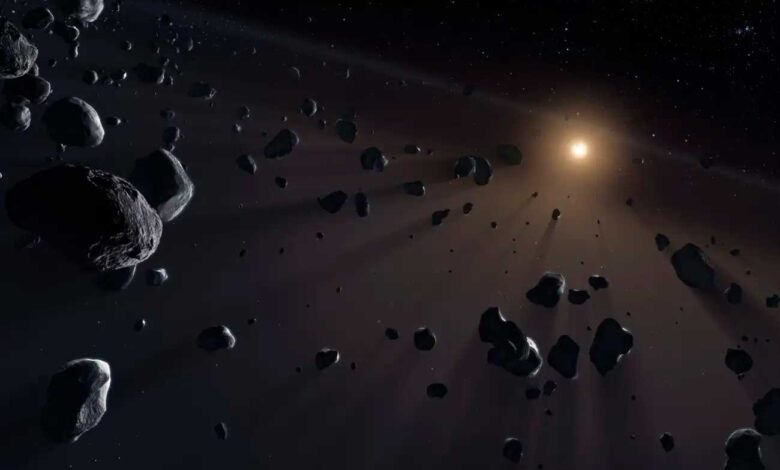
In the distant regions beyond Neptune’s orbit, more than 4.5 billion kilometers from the Sun, stretches the Kuiper Belt. This area has long been known as a repository of icy and rocky bodies left over from the formation of the planets. Its most famous inhabitant is Pluto, yet until recently, it was believed that the objects in the belt were scattered randomly, forming no noticeable clusters.
In the early 2010s, astronomers first noticed that certain bodies in the Kuiper Belt were moving along similar orbits. This led to the identification of a group called the “kernel,” located about 44 astronomical units from the Sun. The discovery made headlines, but for a long time, no similar structures were found, and many experts thought that all large clusters had already been identified.
Algorithms Reveal Hidden Structures
With advances in computational methods and a wealth of data, researchers gained new insights into the distribution of objects in the Kuiper Belt. A team from Princeton University, using trajectory data from 1,650 bodies, applied a special algorithm to search for patterns. The program first successfully pinpointed the known “kernel,” but then uncovered another group that had previously gone unnoticed.
The newly identified cluster, named the ‘inner core,’ is located closer to the Sun—about 43 astronomical units away. What makes this structure unique is that all its objects follow nearly perfect circular orbits, aligned within the same plane as the major planets. This level of order suggests an ancient origin and minimal influence from external factors since the Solar System formed.
The impact of Neptune’s migration and the significance of the discovery
The discovery of the inner core could shed light on the processes that occurred in the early history of the planetary system. Current theories suggest that Neptune originally orbited closer to the Sun and gradually shifted outward over time. During this journey, the giant planet may have temporarily gathered groups of icy bodies around it, forming stable clusters at specific distances. As Neptune continued its path, these formations remained in place, serving as a kind of ‘marker’ of its migration.
The location and characteristics of the identified cores allow scientists to pinpoint Neptune’s migration stages with high precision. This opens up new opportunities for reconstructing the Solar System’s formation history and understanding the mechanisms that have shaped its current appearance.
Future research and potential discoveries
In 2025, the Vera Rubin Observatory in Chile began operations, equipped with state-of-the-art instruments for observing distant objects. It is expected to discover thousands of new bodies in the Kuiper Belt in the coming years, allowing for more detailed study of known structures and the identification of new ones.
It is important to note that the current conclusions are based on the analysis of statistical data and computer models. While researchers are confident in the existence of an inner core, final confirmation will require direct observation. Only then can the nature and origin of this mysterious cluster be determined with certainty.
The discovery of the Kuiper Belt’s inner core could help unlock many mysteries related to planetary evolution and the dynamics of the outer reaches of the Solar System. New data and technologies promise an especially exciting time for astronomy in the coming years.