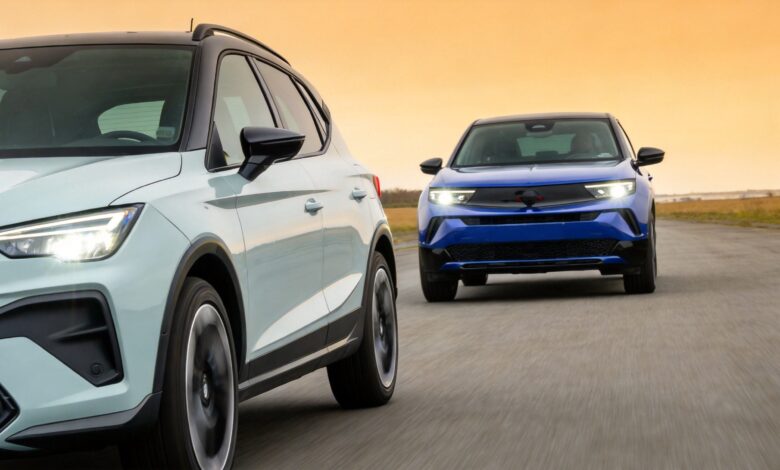
The compact SUV market has long ceased to be homogeneous: even models of similar format can surprise with different solutions. A comparison between the Seat Arona 1.5 TSI and Opel Mokka Hybrid clearly demonstrates how modern technology influences everyday use and the perception of a car. Buyers choosing between these vehicles face unexpected compromises that are not always obvious from the technical specifications.
Technology and fuel consumption
The Opel Mokka Hybrid stands out with its mild hybrid system featuring a 48-volt electric drive, which on paper promises fuel savings — the claimed consumption is 4.9 liters per 100 km. In practice, according to russpain.com, this figure rises to 6.5 liters, bringing it close to the Seat Arona 1.5 TSI, which lacks electrification and uses a cylinder deactivation system. The Spanish crossover shows 6.8 liters per 100 km, just 0.3 liters more than its rival. The real-world difference is minimal, despite the different approaches to reducing fuel consumption.
In terms of dynamics, the Seat Arona 1.5 TSI has the edge thanks to more precise handling and a better connection to the road. Its seats offer confident support, and the driving position makes you feel like part of the car. The suspension effectively smooths out rough surfaces, which is especially noticeable on poor roads. The Opel Mokka Hybrid, despite the help of the electric motor, feels lively only when starting from a standstill, and its advantage on the move is barely perceptible. However, Opel wins in acoustic comfort: the three-cylinder engine runs more quietly, and vibrations are scarcely felt in the cabin.
Comfort and practicality
Inside, the Opel Mokka Hybrid looks modern, though some interior materials are of lower quality. The instrument graphics and climate control are user-friendly and deserve praise. The Seat Arona 1.5 TSI has a more classic cabin design, but the ergonomics are well thought out: the DSG lever fits comfortably in your hand, and the steering wheel and dashboard buttons allow you to quickly control key features. However, Arona’s better-supporting seats come at an extra cost, while Opel offers them as standard, though the backrest provides less body support.
The rear seat in the Opel Mokka Hybrid is more cramped: passengers’ knees quickly touch the front seats. The Arona offers a bit more rear space, and its bench is more suited for long trips. Seat also offers a larger trunk—from 400 to 1280 liters versus Opel’s 350–1105. In terms of payload, the Spanish model is again ahead: 521 kg versus 441 kg for its competitor.
Safety and braking
The Opel Mokka Hybrid sets the pace in braking efficiency: from 100 km/h, it stops in 34.3 meters—almost two meters shorter than the Seat Arona 1.5 TSI (36.1 meters). This matters in urban settings, where quick stops can prevent trouble. Both cars offer stable handling during maneuvers and reliable stability systems, raising driver confidence. Environmentally, Opel’s hybrid setup isn’t just for economy—it allows electric driving in the city and energy recuperation while braking.
Interestingly, approaches to technology development in the SUV segment are becoming increasingly diverse. For example, Volkswagen recently surprised the market with a new name and concept for its electric car, which was analyzed in detail in the article about Volkswagen’s unexpected strategic shift. This shows that even established brands are capable of changing the rules by offering fresh solutions.
Ultimately, the choice between the Seat Arona 1.5 TSI and the Opel Mokka Hybrid depends on your priorities: some value dynamics and space, while others prefer quietness and confident braking. Both crossovers demonstrate that modern technologies don’t always guarantee a clear advantage, and real-life experience often differs from advertising promises.
Seat is a Spanish brand that has actively developed a range of city and family cars since the 1980s. The Arona model appeared in 2017 and quickly became popular thanks to its compact size, practicality, and modern technology. Opel, meanwhile, has long been known in Europe as a manufacturer of reliable and affordable cars, and the Mokka Hybrid is an example of introducing hybrid solutions to the mass market. Both manufacturers continue to compete, offering new options and improving comfort for drivers and passengers.