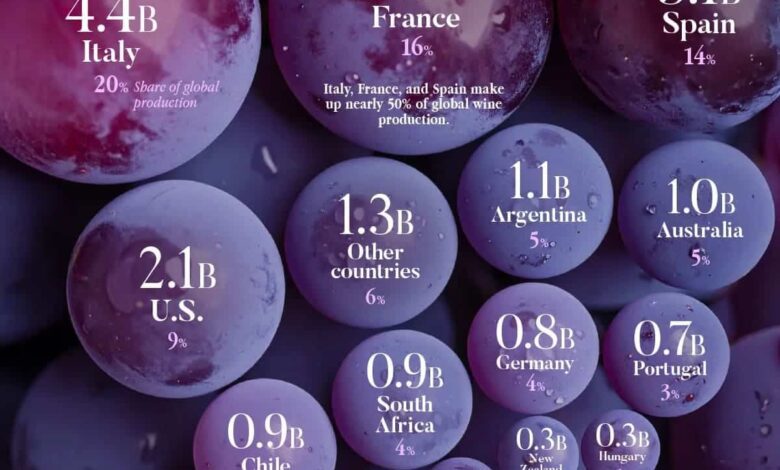
The wine industry is facing challenging times: in 2024, global wine production volumes dropped to their lowest levels in decades. According to the latest data, total output reached 22.6 billion liters, almost 5% less than the previous year. This drop marks the most significant decline since the early 1960s and highlights profound changes in the global wine sector.
European heavyweights: who remains on top
Despite the overall decline, European countries continue to lead the world in wine production. Italy once again tops the rankings with 4.4 billion liters produced—nearly 20% of all the wine made globally. France, long considered a symbol of wine culture, came second with 3.6 billion liters. Spain rounds out the top three at 3.1 billion liters. Together, these three countries account for nearly half of the world’s wine production.
However, even the established leaders in the industry are experiencing a downturn. Shrinking vineyard areas, unfavorable weather conditions, and economic challenges are putting pressure on producers. Wine regions are compelled to adapt to new realities in order to retain their positions in the global market.
Outside Europe: new wine capitals emerge
Among the countries outside the European top three, the United States stands out. They account for 9.4% of global wine production, with the majority coming from California. Argentina, Australia, and Chile also show stable results, forming the second group of leading producers. These countries are actively developing their exports, which helps them remain competitive even amid declining global demand.
In recent years, wineries outside Europe have invested in new technologies and grape-growing methods to confront climate challenges. This enables them not only to maintain production volumes, but also to offer the market new varieties and flavors.
Reasons for decline: climate, economy, and shifting consumer tastes
The drop in wine production is due to a combination of factors. First, vineyard areas are shrinking, directly impacting harvest volumes. Second, extreme weather events—droughts, frosts, hail—are increasingly causing crop losses in key regions. Third, economic instability and rising product costs are holding back demand for wine, especially among young people, who are more frequently choosing other beverages.
Since 2000, there has been a steady global decline in wine consumption. While this drink was once an integral part of many countries’ cultures, today its popularity is gradually giving way to new trends. High prices and changing lifestyles are also contributing to the drop in demand.
Global implications for the market
The decline in wine production and consumption is impacting the entire industry. Lower volumes are driving prices up, which in turn further limits wine’s accessibility to a broader audience. Wine producers are being forced to adopt new strategies: introducing innovations, diversifying their product lines, and entering new markets.
Experts note that the situation could only change in the coming years if comprehensive support measures are implemented and the industry adapts to evolving conditions. Otherwise, the global wine market will continue to shrink, with traditional winemaking regions at risk of losing their influence.
If you didn’t know: International Organisation of Vine and Wine
The International Organisation of Vine and Wine (OIV, Organisation Internationale de la Vigne et du Vin) is a leading intergovernmental body focused on viticulture and wine production. Established in 1924, its headquarters are in Paris. The OIV includes over 40 countries, representing more than 85% of global wine production. The organization develops quality standards, conducts scientific research, analyzes market trends, and provides consultancy support to member states. OIV also collects and publishes statistical data, enabling industry monitoring and identification of key challenges. Through its activities, wine-producing countries are able to coordinate their actions, share expertise, and implement innovative solutions. In recent years, OIV has placed special emphasis on sustainability, climate change adaptation, and support for small producers. The organization’s work helps preserve winemaking traditions and fosters the industry’s growth on a global scale.