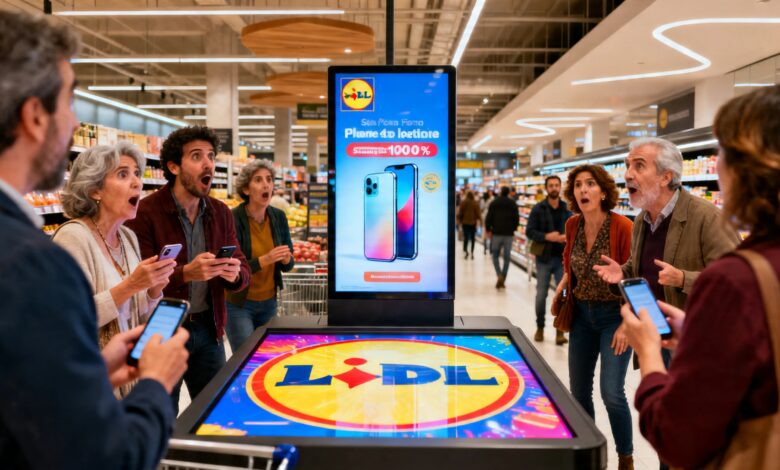
The arrival of Lidl on Spain’s mobile communications market could change the rules of the game for millions of shoppers. The company, known for its stores and promotions, has now set its sights on a sector long dominated by Digi and major operators. For customers, this means new opportunities for savings and convenience, while for the market, it signals increased competition and the potential for lower prices.
Unlike its competitors’ usual strategies, Lidl is not just expanding its product range in stores. Instead, the company has decided to invest in mobile communications, drawing on experience from other European countries. According to Talent24h, parent company Grupo Schwarz has acquired nearly 10% of 1Global, an operator already working in Spain using Orange’s infrastructure. This opens a direct path for Lidl to launch its own virtual operator (OMV), focusing on low rates and simple sign-up through the Lidl Plus app.
Lidl’s strategy
The key focus is integrating mobile communications into the Lidl Plus ecosystem. The app, already used by millions of Spaniards for discounts and promotions, will become the control center for the new service. This approach allows Lidl to quickly reach a broad audience, offering customers not only products but also connectivity at minimal cost. At a time when consumers are increasingly looking for ways to save, such an initiative could prove especially popular.
The Spanish OMV market is already saturated, but Lidl has a key advantage — a vast network of stores across the country. This not only allows for promotion of the new service, but also offers support and consultations directly at retail locations. According to russpain.com, this model has already proven successful for other retailers, such as Eroski and Carrefour, who were the first to offer mobile services to their customers.
Reasons for Interest in OMVs
In recent years, more and more companies unrelated to telecom have entered the virtual operator market. The reason is simple: low startup costs and the opportunity to quickly generate additional profit. For retailers, it’s also a way to retain customers by offering not just products, but also telecom services in a single app. This approach has already been tried by fintech companies like Revolut and N26, as well as major online stores such as PcComponentes.
For consumers, this means more choice and the ability to select a plan that fits their needs. However, experts advise carefully reviewing the conditions of new offers: sometimes an attractive price hides limits on speed or data volume. In any case, the arrival of new players pushes the market toward lower prices and better service.
Opportunities for Customers
If Lidl does launch an OMV in Spain, customers will be able to connect directly through Lidl Plus. The main focus is on simplicity and low cost. For many shoppers, this could be a decisive factor, especially if the service is supported in stores nationwide. However, it’s important to remember that the market is already saturated, and Digi still holds the lead among budget operators.
Potential users should compare Lidl’s offers with those of other OMVs to find the best option. It’s important to consider not only the price, but also the quality of service, support, and additional features. As Talent24h notes, the success of the new service will depend on how well it can stand out from the competition.
Competition with Digi
Despite Lidl’s ambitions, Digi remains the main player among low-cost operators in Spain. The company has already surpassed many competitors and continues to grow its customer base. In the coming months, Digi plans to overtake Vodafone in number of subscribers, reaffirming its market leadership. In this situation, Lidl’s entry will add more competition, but is unlikely to immediately shift the market balance.
Nevertheless, for consumers this is a definite advantage: new offers force operators to cut prices and improve their services. Just remember how a unique restaurant recently opened in Torre del Mar, where you can buy fresh fish and taste it right away— formats like this quickly catch on with customers and change familiar consumer patterns.
Grupo Schwarz is one of Europe’s largest retailers, owning the Lidl and Kaufland chains. The company is actively investing in new areas to maintain its market position and offer customers more than just groceries. In recent years, Lidl has been expanding its product range and introducing digital services, focusing on convenience and savings for shoppers. Launching its own mobile operator is a logical step in this strategy and could set a new trend for the entire retail sector.