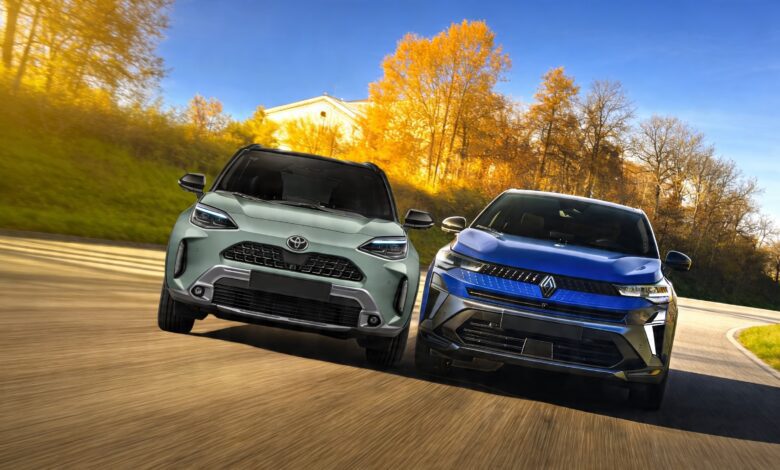
Choosing between the Toyota Yaris Cross and the Renault Captur can affect both your family budget and daily convenience. Both cars are in the compact crossover segment with hybrid technology, but differences in price, trunk space, and engine range make each one suitable for different needs. Buyers seeking a versatile car for city and out-of-town trips discover some surprising nuances when comparing these models.
The Renault Captur stands out not only for its lower starting price, but also for its spacious trunk, which is especially important for families with children. The Toyota Yaris Cross, in contrast, is only available as a hybrid, which ensures it always carries an eco-friendly badge, but limits options in terms of power and trim levels. As fuel costs and taxes become increasingly important, these details gain extra significance.
Dimensions and trunk space
The Renault Captur is both longer and wider than its rival, directly impacting interior space. It measures 4,239 mm in length, 1,797 mm in width, and 1,575 mm in height, with a wheelbase of 2,639 mm. The Toyota Yaris Cross is more compact: 4,180 mm long, 1,765 mm wide, and 1,595 mm high, with a wheelbase of 2,560 mm. This size difference allows the Captur to offer a 487-liter trunk, while the Yaris Cross is limited to 397 liters. For families who often transport strollers or large purchases, this could be the deciding factor.
Despite similar exterior dimensions, the Captur offers noticeably more interior space and easier loading. This is especially evident during long trips or when transporting sports equipment. In urban settings, the Yaris Cross’s compact size can be an advantage, but for more versatile use, the French model holds the edge.
Engines and fuel consumption
Renault Captur offers three engine options: a 115 hp TCe petrol engine with manual transmission, a 140 hp TCe mild hybrid with automatic, and a full E-Tech hybrid delivering 160 hp. The most efficient is the hybrid, consuming just 4.4 L/100 km. The base petrol engine uses 5.7 L/100 km, while the mild hybrid requires 5.9 L/100 km. This range allows you to choose the optimal blend of power and efficiency for various needs.
The Toyota Yaris Cross comes only with a hybrid setup based on a 1.5-liter petrol engine and an electric motor, together producing 130 hp and 185 Nm of torque. Both front-wheel and all-wheel drive versions are available. Fuel consumption ranges from 4.5 to 4.8 L/100 km for front-wheel drive and up to 5.1 L/100 km for all-wheel drive. The constant hybrid system ensures an environmental badge but does not offer more affordable trim options.
Price and equipment
The Renault Captur starts at €22,225, making it one of the most affordable hybrid crossovers in its segment. The Toyota Yaris Cross is significantly more expensive — from €27,500. The €5,000 difference is especially notable given that both models belong to the mass-market segment. For this price, the Captur offers a digital instrument cluster, a multimedia system with a 10.4-inch vertical display, a rearview camera, climate control, and an extended set of electronic assistants as standard.
The entry-level Yaris Cross Business comes equipped with 16-inch wheels, a leather steering wheel, roof rails, Toyota Smart Connect multimedia system with a 9-inch screen, digital instruments, and a rearview camera. The list also includes power mirrors, automatic climate control, and an electric parking brake. However, additional options require extra payment, and the choice of configurations is limited.
Practicality and Value
For families with one child, the Renault Captur offers a more rational choice thanks to its large boot and the ability to select an engine to suit individual needs. Saving €5,000 allows for extra spending on options or insurance. The Toyota Yaris Cross leads in eco-friendliness and uses a full hybrid system, but falls behind in capacity and price. As autobild.es notes, the hybrid Captur with 160 hp offers better dynamics and efficiency than the sole Yaris Cross variant.
As the hybrid crossover market becomes increasingly competitive, the variety of engine options and the availability of entry-level trims play a key role. Analysis by russpain.com indicates that buyers are increasingly choosing models that allow for more personalized configurations, rather than simply opting for the most eco-friendly option. This is further reflected by interest in other updates in the segment, such as the new Mercedes GLE with electrification and numerous upgrades.
Renault Captur is a compact crossover that has become one of the top sellers in Europe since its launch. The model is known for its wide range of engines, spacious interior, and modern technologies. Toyota Yaris Cross, representing the Japanese brand, targets urban drivers who value eco-friendliness and reliability. Both vehicles reflect current market trends where hybrid technology and practicality are decisive factors when choosing a new car.