The decisive phase of the transformation of the Ermita del Santo district has begun in the Spanish capital. Where the once-popular but long-abandoned La Ermita shopping center used to stand, work is now in full swing: heavy machinery is dismantling concrete structures, and residents watch as their familiar landscape disappears into history. This step marks the starting point of a large-scale urban renewal that promises to change not only the appearance of the Latina district, but also its social fabric.
The demolition of the shopping complex is more than just another construction project—it has become a symbol of change for an entire generation of Madrid residents. Authorities and investors insist the project aims to create a modern, eco-friendly, and accessible space, welcoming both young families and outdoor enthusiasts. Yet behind the façade of these ambitious promises lie complex negotiations, financial deals, and battles over every square meter of urban land.
The redevelopment plan
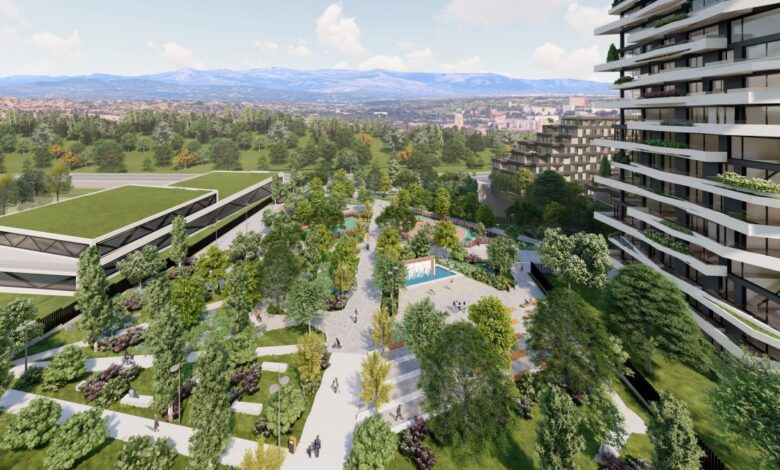
Under the approved plan, 530 new apartments will be built on the former shopping center site, with nearly a third designated as government-supported housing. This move aims to make home ownership more attainable for young families and those who have long dreamed of a place of their own in Madrid. About 70% of the entire area, once held by private owners, will be converted to public use.
City planners have included not only residential buildings, but also extensive public spaces. The project provides for nearly 11,000 square meters of landscaped recreation areas, as well as more than 5,500 square meters of new greenery. Special emphasis is placed on a so-called “green corridor” 60 meters wide, which will link the parks La Ermita del Santo and Caramuel with the popular Madrid Río leisure area.
Infrastructure and public spaces
In addition to residential buildings, Ermita del Santo will feature a modern urban service center. The site of the old commercial hall will be transformed to house shops, cafés, service businesses, and leisure venues. This approach is expected to breathe new life into a neighborhood that has long been considered depressed and unattractive for investors.
An important aspect of the project will be the development of sports and social infrastructure. Nearly 19,000 square meters are allocated for new sports and community facilities. Plans include an indoor swimming pool, gyms, and other venues that will be accessible to all local residents. Officials emphasize that the priority is to create a comfortable environment for living and leisure.
Financial aspects
A project of this scale is impossible without substantial investment. To launch the work, organizers secured funding of 43 million euros, which made it possible not only to start demolishing old buildings but also to prepare the site for future development. Financial partners are confident the investment will pay off through rising property values and by making the district more attractive to new residents.
Construction will take place in stages, with all bureaucratic procedures and approvals taken into account. Major landscaping and infrastructure work is expected to begin in 2026, with project completion planned for the next several years. However, past experience shows that deadlines can shift and plans may be adjusted depending on the economic climate and the interests of stakeholders.
Public expectations
Residents of Latina are closely following events, with both hope and concern. Some look forward to cleaner air, modern parks, and much-needed jobs that the new district could bring. Others worry redevelopment will drive up prices and push long-time residents out. City officials promise to consider the interests of all parties and to make the project as open as possible for public discussion.
Environmental issues and sustainable development hold a special place on the agenda. Designers claim the new buildings will be energy efficient, and the transport infrastructure will be accessible for both pedestrians and cyclists. Plans include expanding public transport routes and developing a network of bike lanes, which should ease road congestion and improve environmental conditions.
A New Chapter for the Neighborhood
Ermita del Santo could become a model for other areas of Madrid where old industrial and commercial zones are gradually giving way to modern residential quarters. If the project is fully implemented, Latina will gain not only new housing but a fundamentally different level of urban environment. However, success will depend on a range of factors—from economic stability to residents’ willingness to embrace change.
In the coming years, the area is set to become a testing ground for urban policy, architecture, and social integration. The main question is whether it will be possible to maintain a balance between the interests of business, authorities, and ordinary citizens. For now, Ermita del Santo remains a symbol of hope for a better future for all of Latina.
By the way, the Junta de Compensación Ermita del Santo is an association of property owners established to coordinate and implement urban development projects in the district. The organization was officially registered in December 2025 and has since played a key role in transforming the area. With 100% representation of landowners, the Junta de Compensación has the legitimacy needed to negotiate with city authorities and investors, as well as to oversee the progress of work and ensure the interests of all stakeholders are protected.