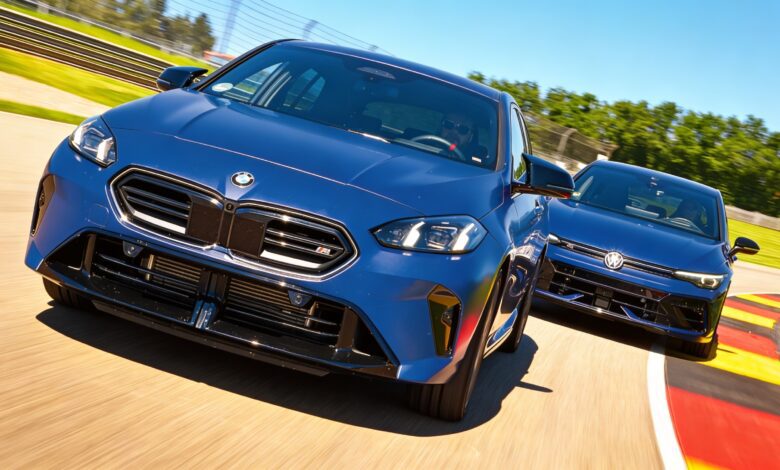
The comparison between the BMW M135 xDrive and the VW Golf R in 2026 prompted a reassessment of modern hot hatchbacks. Both cars received updates aimed at bringing them closer to true sports models, but the result turned out to be more ambiguous. The practical differences became evident not only on the track, but also in everyday driving conditions, where comfort and handling take on special importance.
The BMW M135 xDrive comes with a sports package featuring reinforced suspension, lightweight stabilizers, and new brakes. In theory, this was meant to restore the model’s classic sharpness, but in practice the changes are less radical. The steering is slightly more precise, but the car’s character remains restrained. The interior lacks a true sporty feel: the settings menu is hidden, and suspension modes are limited. The stiff suspension is tiring on regular roads, and the steering does not offer full control over the front axle.
Technology and details
Unlike BMW, the VW Golf R with the R-Performance package offers a broader range of settings. Adaptive dampers with 15 levels of stiffness are available, as well as dedicated track modes and even a drift function. Drivers can quickly tailor the car to their preferences, and the interface is intuitive. On the track, the Golf R displays confidence and stability, allowing even inexperienced drivers to feel more secure. The torque distribution system helps take corners with minimal grip loss, and the engine with updated software responds faster and sharper.
Inside, the Golf R feels sportier: comfortable seats, a clear menu, and precise feedback to driver input. The engine sound is less aggressive but still highlights the character of the model. Brakes and gearbox work in harmony, and launches are quicker than those of its Munich rival. Even after several laps on the track, the Golf R maintains its stability, although the soft Bridgestone tires wear out faster than the Michelin tires on the BMW.
On the track and in the city
On the Sachsenring track, the differences between the models became particularly evident. The Golf R was 1.2 seconds faster, despite the hot weather and tire wear. Its suspension allows for higher cornering speeds, and the all-wheel-drive system works more efficiently. The BMW M135 xDrive, with its new settings, came slightly closer but still could not match the Golf’s lap time. Subjectively, BMW’s handling improved, especially on fast sections, but the lack of steering feedback and limited suspension settings prevented it from fully realizing its potential.
In everyday use, the Golf R has the advantage thanks to its softer suspension and broader customization options. BMW, on the other hand, demands patience from the driver: the stiff suspension quickly becomes tiresome, and sport settings are buried deep in the menus. For those seeking versatility and everyday driving pleasure, the choice becomes clear.
Features and nuances
Both cars come equipped with modern safety systems and electronic assistants, but their implementation differs. The Golf R emphasizes simplicity and easy access to settings, allowing for quick adaptation to changing conditions. BMW, in contrast, offers a more closed-off system where many functions require extra steps to activate. This reduces driver engagement and makes the process less intuitive.
Overall, the comparison showed that technological innovation does not always guarantee leadership on the track or in the city. What matters is how these features are implemented and how convenient they are to use. The Golf R managed to combine sporty character with practicality, while the BMW M135 xDrive remained halfway between comfort and driving dynamics.
BMW is a German brand known for its sporty models and innovations in handling and safety. The 1 Series, which includes the M135 xDrive, was long regarded as a benchmark among compact rear-wheel-drive cars. However, the switch to a front-wheel-drive platform has changed how fans of the brand perceive the model. The VW Golf R is the flagship version of the popular hatchback, blending a powerful engine, all-wheel drive, and modern technology. Both models continue to compete for drivers’ attention, offering different approaches to combining speed, comfort, and handling.