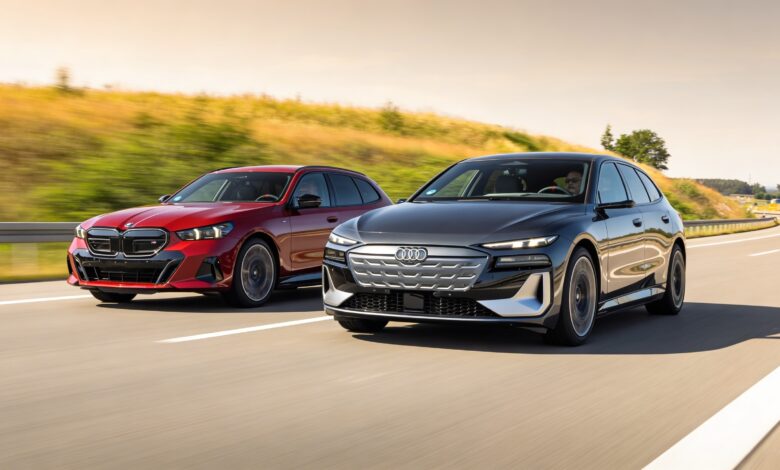
Switching to electric drive in the premium segment is no longer a novelty, but its impact on drivers becomes clear only over time. The BMW i5 M60 Touring and Audi S6 Avant e-tron are two estates that should be benchmarks for those accustomed to power and comfort. Yet in practice, owners face new challenges, from charging nuances to unexpected sensations behind the wheel. It’s not just about how quickly the car accelerates, but also how convenient it is to use every day. Electric technology is reshaping familiar routines—not always for the better.
Expectations in the premium class are always high. Buyers used to powerful engines and luxurious interiors now have to consider not only performance, but also the intricacies of charging infrastructure. Even with impressive specs—the Audi S6 Avant e-tron puts out up to 405 kW, while the BMW i5 M60 Touring uses a unique externally excited synchronous motor—the differences in approach are clear. Audi bets on a larger battery and fast charging, while BMW relies on its proprietary platform and signature handling. But both models face limitations: charging times, complex tariffs, and parking spots that aren’t always convenient. It brings to mind how Tesla simplified charging back in 2013, while today, other brands are still catching up in terms of convenience.
Technology and charging
When comparing technical features, it’s clear that the Audi S6 Avant e-tron leads in battery capacity (94.9 kWh versus 81.9 for the BMW) and charging speed thanks to its 800-volt architecture. This allows for faster range recovery, which is particularly important on long journeys. BMW, on the other hand, uses a platform designed for hybrid solutions and can’t offer comparable charging speeds. In real conditions, the difference between 30 and 20 minutes at a fast charging station might seem minor, but subjectively, waiting feels longer. Moreover, without a charging service subscription, the cost per kilowatt-hour can be surprisingly high—according to RUSSPAIN.COM, public fast charging without a plan often ends up costing more than refueling with gasoline.
Inside, the BMW feels more premium: materials, ergonomics, seating position. However, the high center console may get in the way, especially for drivers with long arms. Audi focuses on space and cutting-edge tech—cameras replacing mirrors, touch panels instead of traditional handles. Still, the quality of some elements raises questions: the plastic on the doors and vents feels less refined than in previous generations. Drivers quickly notice that not all innovations boost comfort.
Performance and impressions
Both station wagons deliver impressive performance: acceleration to 100 km/h takes just a few seconds, and reaching 200 km/h on German autobahns highlights BMW’s advantage at high revs. However, after 200 km/h, both cars reduce pace to prevent the batteries and motors from overheating. In everyday driving, the Audi stands out for its smoothness and linear power delivery, while the BMW responds more sharply to the accelerator, especially in sport mode. During quick accelerations between corners, the BMW feels more aggressive, though in terms of numbers the difference isn’t that great.
Both models handle well, but there are nuances. The Audi S6 Avant e-tron maintains its signature smoothness and predictability, though its body leans more in fast corners compared to the BMW. The latter holds its line with more confidence and seems quicker when changing lanes. At the same time, the Audi’s brakes offer better feedback, and its larger battery allows for a slower use of charge. However, at high speeds, energy consumption rises quickly for both models, making charging stops inevitable. At one of the Audi charging hubs in Nuremberg, drivers are greeted with service and comfort, but charging still costs more than the usual fuel fill-up.
Comfort and details
The interior of the BMW i5 M60 Touring focuses on quality and comfort, though not everyone will appreciate the large central console. The Audi S6 Avant e-tron offers a lighter, airier atmosphere, but ergonomics suffer due to unconventional features: cameras replace the mirrors and take getting used to, while touch panels are not always convenient. BMW’s sound system, created by Hans Zimmer, features electronic tones that may not suit all tastes. Audi delivers a more restrained and pleasant sound that doesn’t distract from driving. Both models come with advanced driver assistance systems, but BMW hides some settings, whereas Audi explains driving dynamics in detail on a special website.
Overall, despite similar technical specifications, the driving and ownership experience of these electric vehicles differs. Buyers accustomed to petrol or diesel versions may be surprised by new details of operation. As russpain.com reports, even major manufacturers are facing unexpected challenges in shifting to electric power — for example, Volkswagen has openly expressed concerns about competition from Chinese electric vehicles, as noted in the article covering risks to the European market. This shows that electrification is not just about technology, but also about infrastructure, habits, and new standards of comfort.
BMW is a German premium car manufacturer founded in 1916. The company is renowned for its engine innovation and driving dynamics, offering a wide range of models from compact to executive vehicles. In recent years, BMW has been actively developing electric and hybrid technologies, introducing new solutions for urban and long-distance travel. The i5 M60 Touring has become a key model in the electric lineup, combining the brand’s traditional values with modern technology. Audi, meanwhile, is part of the Volkswagen Group and is also focusing on electrification, launching models that emphasize comfort, dynamic performance, and digital services.