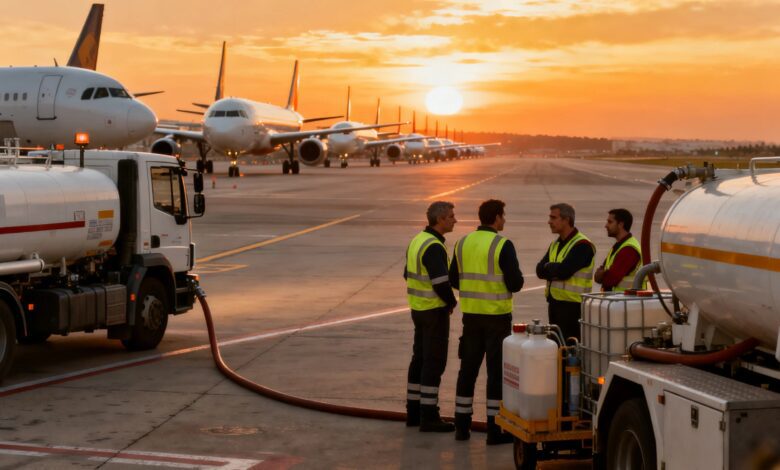
Spanish oil companies have stated they will be able to guarantee uninterrupted supplies of jet fuel only until the end of June. The industry is already seeing increased demand ahead of the tourist season, but further guarantees are impossible due to the unstable global market and the threat of supply disruptions stemming from developments in the Middle East.
According to industry sources, aviation fuel will be delivered in full in May, and oil companies are working to increase reserves and imports for June. However, if the situation in the Strait of Hormuz worsens, disruptions could begin as early as this summer. This could hurt the tourism sector, which is counting on a record influx of foreign visitors.
Meetings with the government
At the start of the week, representatives from Repsol, Moeve, and BP met with Deputy Prime Minister and Minister for Ecological Transition Sara Aagesen. The companies confirmed that May deliveries are guaranteed, and additional measures are being taken for June: national refineries are ramping up production, and overseas purchases are being increased to offset a possible reduction in external supplies, which account for about 20% of the total volume.
Consultations between Aena and Cores are underway in parallel to monitor the situation. Industry sources note that fuel prices are already under pressure, and predicting the outlook even several months ahead is extremely difficult. According to the International Energy Agency, Europe’s aviation kerosene reserves will last about six weeks, while Spain’s will last for 31 days.
Risks for tourism and the economy
Repsol management emphasizes that Spain is in a more advantageous position compared to other EU countries, as 80% of aviation kerosene is produced domestically. Nevertheless, the risk of shortages persists due to the war in Iran and global market instability. Authorities are so far avoiding long-term forecasts, limiting themselves to assurances that there are currently no supply issues.
European officials are less optimistic. Energy Commissioner Dan Jørgensen stated in Madrid that even if the conflict ends soon, it will take months for the oil products market to stabilize. He did not rule out that the European Commission may propose that EU countries jointly allocate fuel reserves to avoid market chaos.
The Spanish government has already expressed its readiness to participate in a pan-European platform for resource distribution. Brussels, in turn, has recommended that companies limit business travel and implement fuel-saving measures. Commissioner for Transport and Sustainable Tourism Apostolos Tzitzikostas noted that mass flight cancellations are not expected this summer, but warned of potentially severe consequences if the diplomatic crisis around Hormuz drags on.
Airlines’ response and implications for passengers
Air carriers are also not ruling out complications. Javier Gándara, head of the Airlines Association, stated that jet fuel supplies in Spain remain stable for now, but disruptions in other countries could affect the local market. Companies are maintaining their planned flight volumes for the summer, but acknowledge that the situation remains extremely uncertain and may change literally from day to day.
Some carriers are already responding to rising prices: Volotea has introduced a fuel surcharge on tickets, and KLM has canceled 80 flights due to increased jet fuel costs. The cause of the shortage is said to be the blockade of the Strait of Hormuz, through which a significant portion of the world’s fuel supplies passes.
Against this backdrop, Spanish authorities and businesses are being forced to respond quickly to new challenges. As with the transition to digital DNI, which was recently reported on RUSSPAIN, new decisions are being made in a short timeframe and could affect millions of residents and tourists.