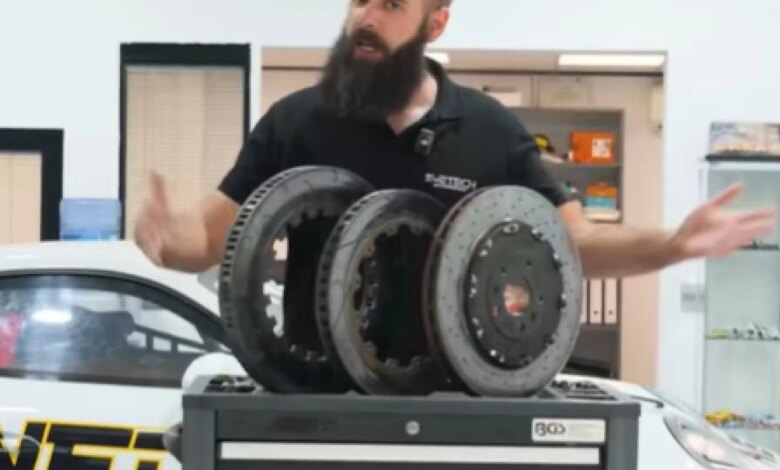
In Spain, many drivers choose between drilled and slotted brake discs in an effort to improve braking performance. However, not everyone is aware that some workshops offer drilled discs that are actually solid with holes added, increasing the risk of cracking and failure.
Drilled discs are not designed for additional cooling, as is often believed. Their main function is to speed up the removal of gases that form when brake pads heat up during intense braking. This helps maintain stable brake system performance at high temperatures.
Nevertheless, these discs have drawbacks. The holes can quickly become clogged with brake pad dust, reducing their effectiveness. Additionally, there is a risk of cracks appearing, especially in the central part of the disc where temperatures are highest. Such damage can cause the rotor to break apart.
Slotted discs also help remove gases and additionally clean the pad surface, preventing crystallization. This improves grip during initial braking. However, like drilled discs, they do not protect against crack formation.
The term “cracking” refers to the appearance of cracks on brake discs caused by thermal stress. Such damage is particularly dangerous as it can lead to part failure and compromise road safety.
As for passing the technical inspection (ITV), both drilled and slotted discs are permitted for use. Issues arise only if the size of the discs is increased, which requires mandatory certification before the inspection.