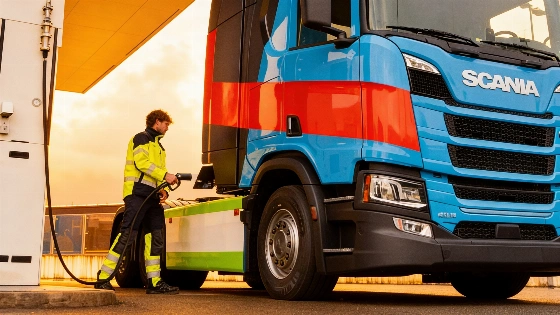
Scania rolls out hydrogen truck with 1,000 km range on Italy’s roads. Scania and Gruber Logistics have started testing the 40 R FCEV hydrogen truck on real-world routes in Italy. The prototype can travel up to 1,000 km without recharging and refuels in less than 20 minutes.
Scania and Gruber Logistics have introduced a prototype 40 R FCEV hydrogen truck on commercial routes in Italy for the first time. The vehicle is already transporting goods for major companies, including Nestlé and Procter & Gamble, making this project one of the most ambitious in European logistics. According to Auto Bild, this is not a laboratory trial but real operations with actual orders.
The main feature of the new truck is a range of up to 1,000 km on a single refueling and the ability to fully refill the hydrogen tanks in less than 20 minutes. This is a key argument for long-haul transport, where downtime is critical and the infrastructure for electric vehicles still does not meet all industry demands.
Unlike most competitors who focus on full electrification, Scania is integrating hydrogen technologies as part of the European ZEFES project. The 40 R FCEV is equipped with a 300 kW (408 hp) fuel cell and a 400 kW (544 hp) electric motor, providing not only high performance but also operational flexibility. Of the 1,000 km range, 690 km come from hydrogen, and another 310 km from the batteries.
The fuel storage system includes four cylinders at up to 700 bar, designed for 56 kg of hydrogen. The truck is rated for a gross weight of up to 44 tons and a payload of about 23 tons. According to Scania representatives, the current prototype is not final: engineers continue to optimize components and reduce system dimensions.
The project is being implemented under the Pilot Partner scheme—the technology is tested in real-world conditions with customer participation to identify all operational nuances before entering the market. The approximate cost of the production version has not yet been disclosed.
Hydrogen is considered a promising alternative for heavy-duty transport, where conventional electric vehicles face limitations in range and charging time. Scania aims to get ahead of competitors such as Volvo and Mercedes by offering a solution for long-distance routes with minimal downtime.
Interest in new technologies in the commercial vehicle segment is growing: manufacturers are seeking a balance between environmental friendliness, economic efficiency, and the real needs of businesses. As Auto Bild notes, the success of such projects could accelerate the industry’s transition to zero-carbon transport.
Amid these changes, it is worth noting that other manufacturers are also showing interest in new technologies: for example, the updated KGM Musso pickup recently appeared on the market, also targeting professionals and distinguished by an honest approach to engineering—more details can be found in the article about the Musso facelift and its features.
Scania plans to launch the production version of the 40 R FCEV as early as next year. If the tests confirm its reliability and cost-effectiveness, hydrogen trucks could become the new standard for long-haul transport in Europe.