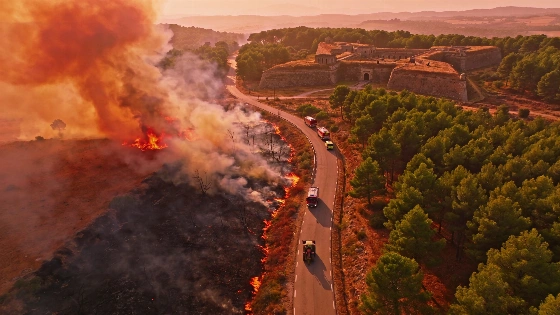
The A-129 road has played a crucial role in halting the wildfire near Leciñena. Key Civil War landmarks and thousands of hectares of pine forest remain at risk. Firefighters and local farmers continue to battle unpredictable flames.
The wildfire raging near Leciñena has put the Sierra de Alcubierre’s forests and historic Civil War sites in jeopardy, but the A-129 road has so far served as a vital natural firebreak. This key route, running between Leciñena and Alcubierre, has helped shield the renowned Ruta Orwell and extensive pine woodlands from destruction, though the situation remains unstable and the fire is not yet under control.
Local farmers, who have joined the firefighting efforts, stress that the threat is far from over. The flames have already scorched land north of the A-129, and only a full assessment after the fire is extinguished will reveal the true extent of the damage. The area includes the Loma Orwell on Monte Irazo, a site marked by trenches and fortifications described by George Orwell in 'Homenaje a Cataluña', as well as dense pine forests that are highly vulnerable under current hot, dry, and windy conditions.
Residents like Juan Carlos Borrell from Robres have been working tirelessly, using tractors and even livestock slurry to create makeshift barriers against the advancing fire. Despite these efforts, smoke continues to rise and the fire’s behavior shifts throughout the day, making containment difficult. The Monumento a los Caídos and other historic positions north of the A-129, such as Tres Huegas and Posición de San Simón, may have suffered damage, but confirmation will only come once the flames are fully subdued.
Armando Pérez, a farmer from Montesusín, has seen his livestock farm threatened twice as the fire approached within a hundred meters. He and dozens of other local farmers have coordinated closely, often working in teams to avoid getting lost in the smoke and to maximize their impact. Their tractors, usually reserved for agricultural work, have become essential tools in the emergency response, with economic concerns set aside as they focus on protecting both their livelihoods and the region’s heritage.
This collaboration between local knowledge and official firefighting units has become a cornerstone of the response. Farmers have long advocated for more proactive forest management, including the creation of firebreaks and clearing undergrowth, but previous requests were not approved. Ironically, the current fire has created its own firebreaks in some of the most affected areas.
For many in these small communities, the forest is more than just scenery—it is a living part of their family history. The pine woods, painstakingly replanted over the past fifty years after being depleted during the Civil War, now face a renewed threat. The emotional toll is evident among residents who have watched decades of growth put at risk in a matter of days.
Wildfires have become an increasingly frequent challenge in Spain, with climate conditions and land management practices playing significant roles. The situation in Leciñena echoes recent incidents elsewhere in the country, such as the major blaze in Catalonia that forced lockdowns in several towns—details of which can be found in this report on the Les Gavarres wildfire. These events highlight the ongoing vulnerability of rural and forested regions, as well as the importance of coordinated local and official responses.
As the fire continues to burn, the full impact on the Sierra de Alcubierre’s natural and historical legacy remains uncertain. The efforts of local residents and the strategic role of the A-129 road have so far prevented even greater losses, but the situation demands continued vigilance and support.