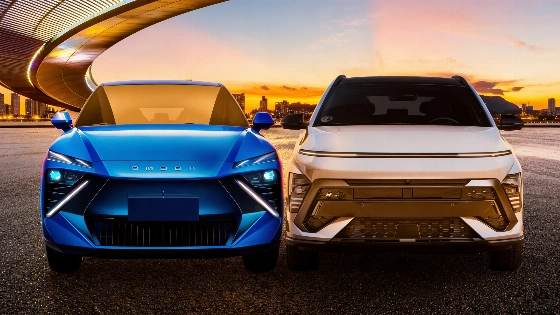
Omoda 4 vs Hyundai Kona: the battle of hybrids and electric cars in the Spanish market. Omoda 4 enters the market with hybrid and electric versions to compete with the popular Hyundai Kona. We compare design, equipment, engines and prices—and find out which crossover might be a better deal for buyers in Spain.
Omoda 4 is a new contender in the compact SUV market, already attracting attention with its combination of hybrid and electric technologies. The model from Chinese brand Chery will arrive in Spain in 2027 and will immediately compete directly with the Hyundai Kona—one of the best-selling crossovers in recent years.
The Hyundai Kona has long established itself in the urban SUV segment thanks to its bold design, a wide range of engines, and solid equipment. In 2025, the Kona became the brand's second most popular model in Spain, selling 15,017 units, and added another 4,687 sales in the first months of 2026. This success is due not only to its recognizable appearance but also to a flexible engine lineup—from petrol to fully electric.
Design and dimensions
The Omoda 4 stands out with its aggressive style: the signature 'Cyber Mecha' design language, with sharp lines and dynamic details, is noticeably different from Chery's usual approach. The length of the body is 4.42 meters, making the Omoda slightly larger than the Kona (4.36 meters). Pricing details remain scarce, but the manufacturer hints at competitiveness, especially for the hybrid version.
The Omoda 4's interior targets a younger audience: its design is inspired by gaming aesthetics, with a vertical central display and a digital instrument cluster powered by a Snapdragon processor. This approach has already appeared in other Chinese models, but here the focus is on technology and individuality.
Technical specifications
The Omoda 4 is built on the T1X platform and will be available in two versions: hybrid and fully electric. The hybrid uses Chery's Super Hybrid System (SHS)—a combination of a 1.5-liter turbo engine and an electric motor, together producing 224 hp, with a 1.83 kWh LFP battery. The electric version comes with a 211 hp motor and a 61.1 kWh battery, providing a range of over 400 km.
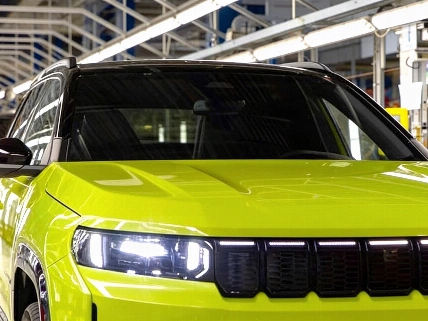
For fans of sporty style, there's an Ultra version with aggressive body kits, a unique Ultra Yellow color, and carbon-look decorative elements.
Hyundai Kona: a proven favorite
The Hyundai Kona offers not just hybrid and electric variants, but also petrol and plug-in hybrid versions. Kona's dimensions are 4.36 m in length, 1.83 m in width, and 1.58 m in height, with a wheelbase of 2.66 m. The base petrol version starts at €23,190, the hybrid from €27,540, and the electric version from €38,050, though with discounts and government programs, the price can drop to €25,590.
Inside the Kona is a minimalist cabin with two displays: a 12.3-inch multimedia screen and an instrument panel (from 4.2 to 12.3 inches depending on the configuration). Despite the abundance of hard plastic, build quality remains high. The rear seats are spacious, and the trunk offers 466 liters of volume (or 493 liters in the electric version).
Engines and charging
The Kona engine range includes petrol 1.0 TGD-i (115 hp) and 1.6 TGDi (150 or 180 hp), a 1.6 GDi hybrid (combined 139 hp), and two electric motors: 135 hp with a 49 kWh battery (up to 380 km range) and 204 hp with a 65 kWh battery (up to 440 km, or up to 510 km in the city). The electric version supports fast charging up to 102 kW, allowing you to recharge from 10% to 80% in about 40–45 minutes.
As russpain.com notes, Chinese manufacturers are increasingly integrating premium technologies even into mass-market models—for example, the BYD Dolphin Surf has received a LiDAR system, which was previously available only in expensive brands. This intensifies competition even in the compact SUV segment.
What to choose?
So far, little is known about the prices and configurations of the Omoda 4, but it is already clear: the Chinese newcomer targets a young audience and can offer a more powerful hybrid than the Kona. At the same time, the Hyundai Kona remains one of the most well-balanced options in terms of price, equipment, and reliability, especially considering the current discounts and electric vehicle support programs in Spain.
The final choice will depend on how aggressively the Omoda 4 enters the market in terms of pricing and what options are included in the basic configuration. But it is already clear: competition in the compact hybrid and electric car segment is heating up, and buyers benefit from greater variety and technological advancement.