Scientists in Austria and China have built the first functional nuclear clocks. The devices are not yet more accurate than the best conventional atomic clocks, but they give researchers a working platform for precision measurement and fundamental-physics experiments.
Nature published two papers on Wednesday describing the first functional nuclear clocks built by independent teams in Vienna and Beijing. The devices are not yet more accurate than the best conventional atomic clocks. Still, the Vienna team used its clock in a precision experiment that searched for dark matter. It found no dark matter, but the system operated at the level of leading atomic clocks.
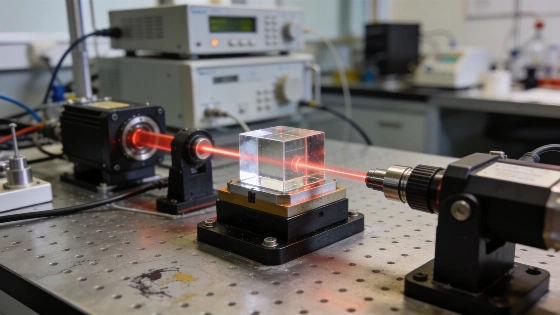
Both clocks use thorium-229 held inside solid calcium fluoride crystals. The teams reached the result through different experimental approaches, so the parallel success shows that the concept does not depend on one technical design. The work follows a decisive advance in 2024, when teams from TU Wien and Physikalisch-Technische Bundesanstalt directly excited the thorium-229 nuclear transition with a laser for the first time.
В 2024 году исследователи TU Wien и Physikalisch-Technische Bundesanstalt впервые напрямую возбудили переход тория-229 лазером. Именно этот шаг сделал создание ядерных часов экспериментально возможным.
Nuclear clocks track a change inside the atomic nucleus, not in the surrounding electron shell. A powerful laser interacts with the nucleus and prompts protons and neutrons to move between energy levels. Conventional atomic clocks track similar transitions among electrons in elements such as cesium or strontium.
Nuclear energy levels are less exposed to some environmental disturbances than electronic ones. That could eventually bring greater long-term stability, although researchers have not achieved that advantage in practice. The nucleus is much smaller than the electron shell around it, so researchers expect nuclear transitions to support greater precision once the equipment improves.
The solid-state design brings its own problem. Large numbers of thorium nuclei sit inside a material with local imperfections. Those imperfections can shift the transition frequency and broaden the spectral line.
Переход тория-229 имеет энергию около 8,4 эВ и длину волны примерно 148 нм. Поэтому его можно возбуждать вакуумным ультрафиолетовым лазером, тогда как переходы большинства других ядер потребовали бы значительно более энергичных гамма-квантов.
Thorsten Schumm of the Technical University of Vienna said his group had pursued the goal since 2008. Shiqian Ding of Tsinghua University helped lead the Beijing project. The scientists described the simultaneous achievement as evidence that the underlying idea is technically sound.
The two systems are complementary rather than identical. Vienna has focused on thorium-doped crystals with a higher concentration and better optical properties. The Beijing system uses a more powerful laser.
For now, both clocks remain well short of their intended performance. The Chinese installation reached a frequency instability of roughly one part in 1015 as the averaging time increased. The Vienna system demonstrated continuous operation for approximately 24 hours. Those results show that the systems work, but they do not surpass the best optical atomic clocks.
The main engineering hurdles include crystal quality and uniformity, laser stability and power, and the difficulty of obtaining enough of the rare radioactive isotope thorium-229 for large-scale production.
The solid-state architecture also produced a further problem. The measured transition frequency changed slightly depending on which part of the crystal received the laser beam. Restarting the experiment or moving the beam could therefore produce small differences in the clock reading.
Future systems will need a more even thorium distribution, tighter control of crystal defects and better optical access to the material. The International Atomic Energy Agency has identified thorium-229 as a scarce isotope, so material supply adds another practical constraint.
Conventional atomic clocks already support systems used every day. Their precision underpins global satellite navigation and helps synchronise internet data transfers, mobile communications and fibre-optic networks. The best of these clocks can run for billions of years with a deviation of only one second.
Nuclear clocks are not ready to replace them. A compact solid-state platform could eventually offer another route to high-precision timekeeping, with equipment that is less bulky and less delicate. Schumm also listed satellite navigation, data-transfer synchronisation, surveying and metrology as possible uses.
Those applications remain future prospects. The next step is more practical: researchers could combine Vienna's higher-concentration, optically improved crystals with Beijing's stronger laser. That pairing could raise performance without requiring a wholly new architecture.
The devices also give physicists a new tool for testing fundamental physics. Possible experiments include searches for dark matter and tests for changes in fundamental constants. The Vienna experiment did not detect dark matter, but it showed that the clock can already support measurements at the level of the best atomic systems. The missing signal is a null result. The clock's technical performance is a meaningful result in its own right.
Two teams have independently made nuclear clocks work, yet neither has surpassed conventional atomic clocks. The technology is now a practical laboratory platform, but its strongest applications still depend on further improvements.