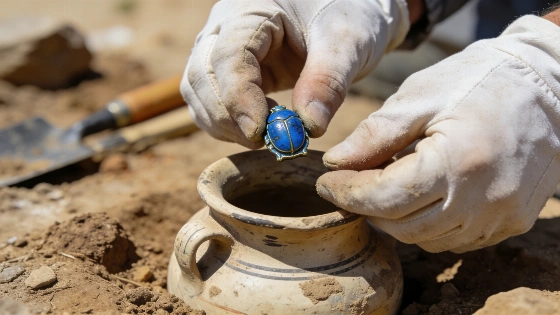
Egyptian Amulet Bearing Pharaoh's Name Found in Ciudad Real Necropolis. An Egyptian scarab inscribed with a pharaoh's name has been discovered in the El Toro necropolis. Experts believe the artifact arrived in Spain via the Phoenicians. The find reshapes our understanding of connections between ancient civilizations.
In the El Toro necropolis, located in the municipality of Alcubillas (Ciudad Real), archaeologists have discovered a unique Egyptian amulet—a scarab bearing the name of a pharaoh. According to specialists, the find dates back to the 7th–6th centuries BC and points to complex trade routes linking Egypt, Phoenician settlements, and the center of the Iberian Peninsula.
The artifact was found in one of three urns in the so-called tomb 5. The urn also contained the remains of a young woman, traces of high-temperature cremation, fragments of charcoal, two glass beads, and two copper plates. The scarab itself is made of blue faience, measures just 1.5 cm in length, and weighs 1.26 grams. The base of the amulet preserves a hieroglyphic inscription—p-s-m-T-k—which corresponds to the name Psamtek, known from Greco-Roman sources as Psammetichus.
Researchers note that similar scarabs with this name have mainly been found in Phoenician-Punic settlements of the Mediterranean. This suggests that the amulet was crafted in the Memphis or Naukratis area and later reached Spain through trade with the Phoenicians. Similar items have been found in Israel, Carthage, Sardinia, and Gibraltar, confirming the wide geographic distribution of such artifacts.
According to archaeologists, the scarab may have served not only as a status symbol but also had a protective function for its owner, both in life and after death. In the case of the El Toro necropolis, the woman’s cremation could have been part of a purification ritual in which the body was wrapped in a shroud and adorned with objects, many of which were not preserved due to the fire.
The find in Alcubillas became one of the few cases when an Egyptian amulet was discovered in a closed archaeological context, allowing for more precise dating and analysis of its journey. As noted by Professor Luis Benítez de Lugo of the Complutense University, such objects are usually found outside their original burial sites, which complicates their study. Notably, it was a woman who became the owner of this amulet, adding details for the study of the role of women in Oretani society.
Interest in ancient artifacts is growing in Spain: recently, the largest cache of medieval helmets was found in Castellón, also sparking debates about the origin and spread of military technologies. More about the discovery of fourteenth-century weaponry can be found in the article about rare helmets off the coast of Benicarló.
For reference: the El Toro necropolis covers about 8,000 square meters and belongs to the territory of ancient Oretania. During the 2016–2017 excavations, 12 burials were identified, five of which contained ceramic urns. The discovery of the Egyptian scarab in this region highlights Spain’s significance as part of the ancient trade and cultural routes of the Mediterranean.