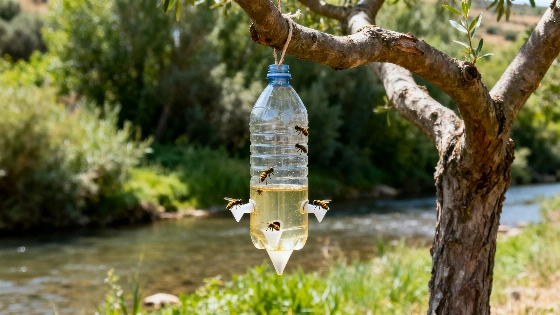
In Aragon, Asian wasps are caught with plastic bottles: saving bees and crops. In Alcañiz, on the banks of the Guadalupe, 62 Asian wasp queens were captured in a month using homemade plastic bottle traps. This approach helps protect local bees and restrain the spread of a dangerous species without harming the ecosystem.
In Alcañiz, a small town in Aragon, an unusually effective method has been found to combat the Asian hornet Vespa velutina—one of the most dangerous invasive threats to local bees and agriculture. Since March, mass installations of traps made from ordinary plastic bottles have begun here, and within just one month, 62 queens have been captured along the Guadalupe River. This is a crucial point: each queen can establish a colony of thousands of individuals, meaning timely capture can prevent the appearance of new nests and reduce the damage to apiaries and crops.
The campaign was prompted by the discovery of nine Vespa velutina nests around the town last summer. The operation is carried out jointly by the municipal forester and the Nature Protection Agents of the Government of Aragon. The traps are placed near water and dense vegetation—precisely where the queens emerge after winter hibernation in search of food and energy.
How the trap works
The design is simple but well thought out: a plastic bottle is hung on a tree, with two opposite slits cut into the side walls, into which funnels made from other bottles are inserted. Fermented bait is poured inside, whose scent specifically attracts Asian hornets. Once inside, the insect cannot escape because of the narrow openings and slippery walls. Importantly, the bait's composition is selected to minimize risk to local bees and other beneficial insects.
Why this matters for the region
Vespa velutina has been actively spreading across Spain since 2010, especially in the northern and humid regions. In Aragón, the highest risk is observed in the Pyrenees, where the climate is milder, but lowlands such as Bajo Aragón also offer favorable conditions for wasp reproduction. According to experts, the success of the campaign in Alcañiz gives cautious optimism but requires ongoing monitoring: even a single missed queen can lead to a new nest.
Rules and risks: what to do if you find a nest
The Asian hornet is officially recognized as an invasive species and listed in the Spanish catalog of ecosystem threats (Real Decreto 630/2013). By law, only trained specialists are allowed to destroy nests—they are often located high up or in hard-to-reach places. Approaching a nest on your own is dangerous: Vespa velutina is not aggressive without reason, but may attack en masse if threatened. It is recommended to keep at least five meters away, avoid causing vibrations, and immediately report any sightings to the appropriate authorities.
How to distinguish the Asian hornet from the common wasp
Vespa velutina is noticeably larger than common wasps: workers reach three centimeters and queens up to three and a half. Their color is darker, with a bright orange band on the abdomen. Typical wasps are smaller and have the characteristic yellow and black 'vest.'
Context: combating biological threats
Spain regularly faces new biological risks. For example, recently fresh cheese was withdrawn in the country due to a listeria threat, which also required a swift response and coordination of services. In the case of the Asian hornet, the focus is on simple yet effective solutions that can be implemented by local residents and specialists.
While monitoring and trap updates continue in Alcañiz, experts advise staying alert: early detection and targeted measures remain the main tools to protect local bees and crops from new waves of Vespa velutina.