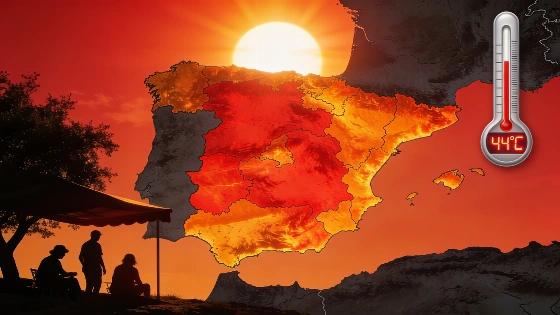
AEMET has issued a warning for a severe heat episode across Spain and the Balearic Islands. Temperatures could reach 44°C in the south. The risk is highest for vulnerable groups and outdoor workers. Nights will remain uncomfortably warm.
Spain faces a new surge of extreme heat as the Agencia Estatal de Meteorología (AEMET) issues a warning for a potentially record-breaking episode starting Saturday, July 4. The alert covers much of the mainland and the Balearic Islands, with the most intense conditions expected in the southern regions. According to AEMET, temperatures could spike to 44°C in some areas, raising concerns for public health and safety.
The forecast points to a combination of atmospheric blocking and a 'dana' (isolated high-altitude depression) west of the peninsula, which will channel a mass of exceptionally hot, dry air northward. This, combined with strong seasonal sunshine, is expected to drive temperatures sharply higher and keep them elevated for several days. The agency has urged the public to take precautions, especially during the hottest hours of the day, and highlighted the increased risk for older adults, people with cardiovascular conditions, and those working outdoors.
Initial temperature rises are expected to become noticeable between Friday, July 3, and Saturday, July 4. Moderate increases will affect most regions, with the most pronounced jumps in the interior north and western Galicia. By Saturday, highs of 36–38°C are forecast for the Ebro and Miño valleys, while the southwest quadrant could see 38–40°C. In the Tajo, Guadiana, and Guadalquivir valleys, these figures may be exceeded. On Sunday, July 5, the situation is likely to intensify, with the north experiencing further increases—temperatures in the Miño valley and interior Galicia, as well as the Ebro valley, could approach 40°C. The southwest is expected to remain the hottest, with highs above 42°C in the Guadiana and Guadalquivir valleys.
Looking ahead to Monday, July 6, AEMET notes growing uncertainty but considers it likely that the heat will spread eastward, southward, and into the Balearic Islands. If this scenario holds, 38°C could become widespread in Castilla-La Mancha, parts of the northern plateau, the southeast interior, and Mallorca. The major river valleys are set to remain the epicenter of the heat, with maximums between 40 and 42°C. There is a possibility that on Tuesday, July 7, some locations in the Guadiana and Guadalquivir valleys could reach 44°C, though AEMET stresses this is still a low-probability outcome.
The duration and intensity of the episode will depend on the final position of the 'dana', making precise forecasts difficult. Current models suggest the heat will persist for several days, potentially meeting the criteria for an official heatwave from Sunday onward. By Wednesday, July 8, temperatures may begin to drop in central and northern Spain, but the south could see continued or even locally increased heat. The agency also warns of heightened wildfire risk during this period, as well as the potential for dry thunderstorms in mountainous areas if the 'dana' moves closer to the peninsula—a pattern that often increases fire danger.
Spain has experienced several intense heatwaves in recent years, with significant impacts on health and infrastructure. During previous episodes, such as the one that led to over a hundred fatalities in June, authorities emphasized the importance of staying hydrated, avoiding outdoor activity during peak heat, and monitoring vulnerable populations. For context, a recent period of extreme heat in Spain resulted in more than 100 deaths in just three days, underscoring the risks associated with such weather events. The current alert from AEMET serves as a reminder of the growing challenges posed by extreme temperatures and the need for preparedness as summer progresses.