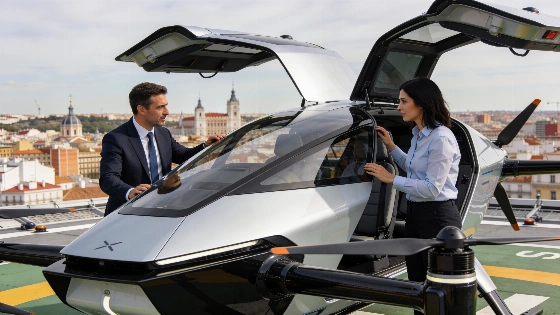
Chinese GAC unveils serial flying taxi in Spain for €214,600. A new player has entered Spain’s urban mobility market—China’s GAC has started production of the AirCab, an electric flying taxi. Designed for short city routes, the model recharges in 25 minutes and is priced at €214,600.
The Chinese automotive giant GAC, which recently entered the Spanish market, has announced the start of mass production for its AirCab electric flying taxi. According to Autobild, the new model is priced at €214,600, with a key feature being the ability to fully charge the batteries in just 25 minutes—a figure that could transform urban mobility.
The AirCab is an eVTOL (electric vertical take-off and landing vehicle) designed to transport passengers over short routes within the city. This format helps bypass traffic congestion and offers an alternative to traditional taxis, prioritizing speed and eco-friendliness. The model is aimed not at private buyers but at transport service operators, which is also reflected in the production approach: GAC focuses on industrialization and cost reduction to accelerate the adoption of this technology in real urban environments.
Technically, the AirCab is built on a fully electric platform with multiple distributed rotors. This architecture provides not only flight stability and maneuverability but also a high level of safety: even if one of the engines fails, the vehicle remains under control. Special attention has been given to ease of maintenance and compliance with strict operational requirements in densely populated areas.
Fast charging is one of AirCab’s main selling points. In urban environments, where downtime is critical for business, the ability to recharge in 25 minutes supports high trip frequency and minimizes idle periods. This gives it a competitive edge over other projects currently limited either by range or lengthy charging times.
AirCab’s design is marked by a restrained futuristic style: the cabin is focused on passenger comfort, with a minimalist interior closer to premium cars than traditional aircraft. This approach reflects GAC’s ambition to make urban air transport not only technologically advanced, but also user-friendly.
The arrival of AirCab in Spain could be a significant step for the European market: dense urban development and a growing need for sustainable transport solutions make the country a potential testing ground for such technologies. However, as experts note, the mass adoption of eVTOL in cities will depend not only on technical specifications, but also on the readiness of regulators, infrastructure, and society for new forms of mobility.
GAC, which has experience collaborating with Honda and Toyota, demonstrates that traditional automakers are ready to go beyond conventional solutions and invest in integrated ecosystems: from electric vehicles to digital platforms and air transport. If the AirCab project receives support from local authorities and operators, Spain could become one of the first countries in Europe where flying taxis become part of everyday life.