Carlos Alcaraz dropped the first set to Jaime Faria but quickly took control to advance at the US Open. With top rivals missing or struggling, Alcaraz looks healthy and ready to defend his title.
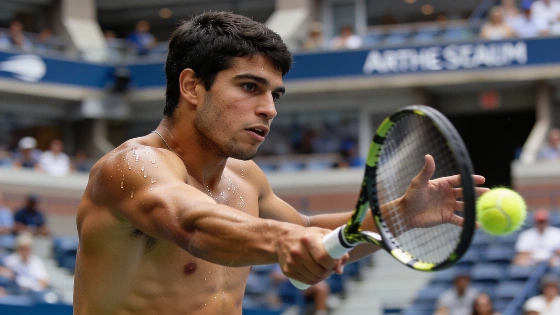
Carlos Alcaraz nearly stumbled out of the gate at the US Open, but after a rough first set against Portugal’s Jaime Faria, he found his footing and took over the match. Alcaraz dropped the opener but came back to win 4-6, 6-0, 6-3, 6-2, finishing the job in just over two and a half hours on Arthur Ashe Stadium.
The match shifted after a tense moment when Alcaraz, frustrated with his serve and trailing, let his team know exactly how he felt. That outburst seemed to snap him back into focus. From there, he won eight games in a row and never looked back.
The 2026 US Open is the 146th edition of the tournament and is being held from August 23 to September 13 at the USTA Billie Jean King National Tennis Center in New York.
This turnaround comes at a time when the tournament is wide open. Jannik Sinner and Novak Djokovic are out, and other contenders have struggled. Alcaraz, the defending champion, arrived in New York after a four-month injury break, but he looked sharp and aggressive—much like the player who won here last year. His forehand was back to full power, and his serve hit 210 km/h late in the match, a sign that his confidence and fitness have returned.
Faria, who relies on a big serve and attacking style, pushed Alcaraz early and forced mistakes. But once Alcaraz settled, the match swung his way. Faria had already played a five-setter against Jenson Brooksby in the previous round, which may have left him short on energy. Alcaraz’s ability to adjust and take control under pressure is a big reason he’s now seen as the favorite.
Next up for Alcaraz is China’s Wu Yibing, with possible matches against Alexander Bublik and Ben Shelton ahead. The draw has opened up, and Alcaraz’s form suggests he’s hitting his stride at the right time.
Before facing Faria, Alcaraz played his first match at the 2026 US Open against Roman Safiullin, securing a straight-sets victory (6-4, 6-4, 6-4) after a four and a half month break from competition. This detail, confirmed by official match coverage, clarifies the actual length of his absence prior to the tournament.
While upsets are always possible, Alcaraz’s performance stands out for its clarity and intent. His frustration, quick adjustment, and then total control show how he handles pressure on the biggest stage. In a season where other favorites have faltered, Alcaraz’s recovery and renewed aggression put him in a strong position.
Major tournaments are often unpredictable, as recent sports coverage has shown. Here, the stakes are different, but the lesson is similar: resilience and decisive play matter most when the usual favorites are missing.
Alcaraz’s win is more than just another step in the bracket. He’s shown that questions about his wrist and fitness have been answered on court. If he keeps playing like this, he could defend his title. With the field missing its biggest names, Alcaraz’s ability to take charge is now the standard for winning at this level.