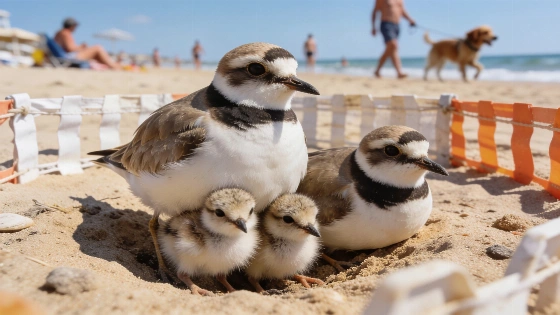
A vulnerable Kentish plover nest was shielded from beachgoers and pets in Guardamar del Segura thanks to quick action by residents and local authorities. Two chicks hatched and left the nest, highlighting the delicate balance between tourism and wildlife on Spain’s Mediterranean coast.
When several residents in Guardamar del Segura noticed a Kentish plover nest dangerously close to a busy beach walkway, their swift alert set off a coordinated response that ultimately gave two rare chicks a fighting chance. The nest, belonging to one of the Mediterranean’s most threatened shorebirds, was found outside the usual protected zones on Les Ortigues beach, just steps from a popular access point.
Local authorities from Guardamar del Segura and Torrevieja moved quickly after being notified by citizens, who flagged the nest to Torrevieja’s environmental police unit. Technical teams from both municipalities inspected the site and agreed on immediate measures to reduce the risk of accidental disturbance, especially as the area saw a surge in visitors and pets with the arrival of warmer weather.
Emergency Protection Measures
The first step was to install a temporary exclusion barrier around the nest, designed to allow adult birds access while keeping people and animals at bay. A second perimeter was later added to further distance beach users from the vulnerable site. Importantly, the intervention was carried out without handling the eggs or disturbing the adult birds, minimizing stress for the species.
This rapid response was coordinated with environmental agents from the Generalitat Valenciana and the regional Department of Environment, as well as conservation groups like Territorio Natura/Xaloc and Chorlitejos y Patinegros, GESNET Servicios, and the local police of Guardamar del Segura. Ornithologists and naturalists familiar with the coastline also joined the effort in the following days, providing expertise on the species’ needs and habitat.
Risks from Human Activity
The Kentish plover (Charadrius alexandrinus) is listed as a vulnerable species in the Valencian Catalogue of Threatened Fauna and Flora. Its nesting sites are increasingly at risk due to habitat loss, heavy beach use, and the presence of dogs and stray cats. The nest in Guardamar was especially exposed: close to a walkway, in an area not previously marked for protection, and subject to frequent foot traffic and pets.
According to SEO/BirdLife, Kentish plovers rely on undisturbed beaches, coastal dunes, and salt flats—habitats that have been dramatically altered in recent decades. The Diputación de Valencia also points to mechanized beach cleaning during breeding season as a significant threat. In this case, the community’s vigilance was crucial: many beachgoers respected the new boundaries and even helped report potential problems, showing how public awareness can make a tangible difference.
Successful Hatching and Lessons Learned
The outcome was a rare success. After a full incubation period, two chicks hatched and, within hours, left the nest with their parents for the nearby dunes. Technical teams say the experience offers valuable insights for managing unexpected nesting events in high-traffic coastal areas. While each case requires tailored solutions, the result underscores the importance of collaboration between local governments, conservationists, and the public.
Protecting the Kentish plover remains a challenge as Spain’s Mediterranean beaches grow ever more popular. Balancing tourism with biodiversity is a delicate task, especially as climate risks and coastal hazards—such as those highlighted in recent warnings about Mediterranean coastal threats—add further pressure to fragile ecosystems. For now, the successful hatching in Guardamar stands as a reminder that quick action and community involvement can tip the scales for species on the brink.