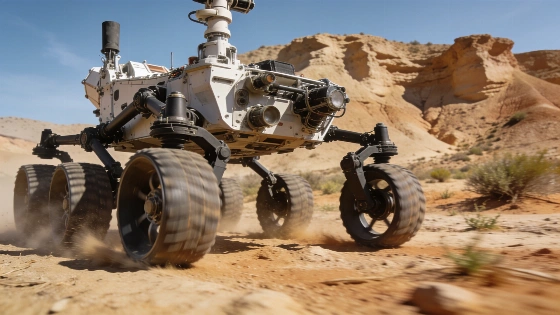
A Spanish-built landing system is entering its final qualification stage. ESA will test a Mars rover prototype in Almería before the 2028 mission.
The European Space Agency will test a Mars landing system in Almería from 30 September to 2 October 2026. The Desierto de Tabernas will host the campaign, with 1 October set as its main test day. Engineers will assess autonomous navigation and scientific procedures planned for the ExoMars mission in 2028.
The hardware is not the rover itself. It is the landing gear. Spanish group Sener built the system with four legs that will stay folded during the journey to Mars. They will deploy automatically just before the descent platform reaches the surface.
Airbus is using an ordinary Steam Deck as a remote control for the Charlie prototype during the field campaign, an unusual but practical detail that highlights the engineering and operational nature of the tests.
Engineers will operate the Charlie demonstration vehicle remotely from Turin. The desert terrain will help them check technologies and procedures that must work without direct manual control on Mars. The trial will also recreate selected scientific tasks planned for Rosalind Franklin. Charlie is a ground-based technology demonstrator. It is not the flight rover.
Rosalind Franklin will search for possible traces of life and study Mars' geochemical environment. Its drill will reach two metres below the surface. It will collect samples from below the ground and analyse their composition. Those samples could come from material protected from radiation and the harsher conditions at ground level.
The ExoMars landing platform combines mechanical, thermal and propulsion systems with the landing structure and ramps used for rover egress. Airbus engineering materials describe the platform as a system designed to stabilise after touchdown and enable the safe deployment of a heavy rover.
The landing sequence allows little room for error. Sener's legs must unfold in two pairs after the front heat shield separates. Non-explosive actuators will drive the movement. Tests have shown that deployment can take less than one second. The platform must then be ready for touchdown.
That is a tight window.
Sener designed and manufactured all four legs for the mechanical and environmental demands of the journey and landing. The legs will work with the parachutes and engines that slow the spacecraft before it reaches the Martian surface. Sener, Thales and Airbus have already completed structural, environmental and functional tests.
Work became harder after cooperation between the ESA and Roscosmos ended. European industry had to replace Russian systems planned for the descent and landing phase. The programme still had to protect its target launch date in 2028. Sener's qualification model is now completing its final tests. Flight units are due for delivery in the fourth quarter of 2026, according to recent project reporting.
Sener's work covers more than the landing legs. The company is also responsible for the entry capsule's separation mechanisms and adapter. Its tasks include UHF communication antennas, the drill's positioning and translation system, and deployment mechanisms for the solar panels and X-band and UHF antennas. From Poland, Sener has developed the umbilical release mechanism known as URM. It will maintain the electromechanical connection between the rover and descent module.
URM must supply electrical power to the rover after landing. It must also keep working in the extreme Martian environment. The comparison with terrestrial engineering is stark. an earlier technology report described equipment and training moving across Spain and Portugal. This programme requires components to survive a one-way journey to another planet.
ExoMars will be Sener's third Mars mission. The company previously supplied antenna-pointing mechanisms for NASA's Curiosity and Perseverance rovers on the Mars Science Laboratory and Mars 2020 missions. The Tabernas campaign is therefore a final qualification step for a system that must deploy quickly and absorb the impact of landing. Its performance will affect whether Rosalind Franklin's instruments can operate on Mars. ESA campaign materials place the tests in the programme's active final ground-preparation phase before work moves to flight hardware.