At Casa Velázquez in Madrid, Emmanuel Macron honoured Pedro Almodóvar as an officer of the Legion of Honour and Javier Cercas as an officer of the Order of Arts and Letters. His speech tied their work to Spain's democratic story and Europe's shared culture.
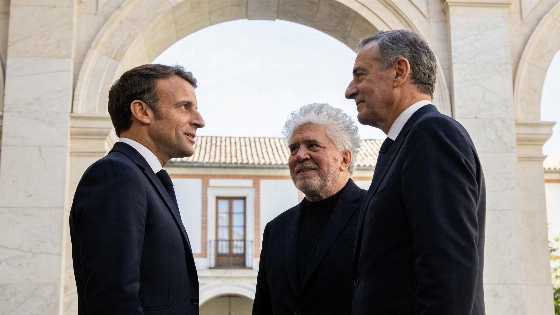
On 30 September 2026, Pedro Almodóvar and Javier Cercas stood before Emmanuel Macron at Madrid's Casa Velázquez. The French president made Almodóvar an officer of the Legion of Honour and Cercas an officer of the Order of Arts and Letters. The ceremony took place during Macron's state visit to Spain.
After Macron finished speaking, he asked both men to leave their chairs beside the lectern. He stood in front of them beneath Casa Velázquez's marble arch. Sunlight fell across his forehead as the two honourees faced him at close range. The formal republican ritual followed.
A day before the ceremony, Javier Cercas had already taken part in a public discussion with Emmanuel Macron and students in Madrid. Reports noted that the French president and the writer had known each other since 2023.
Macron's speech set out the event's main idea. Almodóvar and Cercas have helped audiences outside Spain understand the country. He began with Almodóvar's childhood in La Mancha, where the future filmmaker collected actors' cards from chocolate bars.
Macron then turned to the director's language of desire, transgression and freedom. He spoke about the mothers and imperfect women at the centre of Almodóvar's films. In his account, those characters showed a cinema that followed Spain's social change and ignored conventional limits.
The president also returned to Almodóvar's almost French sensibility. Almodóvar replied with a quiet merci beaucoup.
This was not Almodóvar’s first French distinction. AFP, in a report republished by BTA, recalled that he had already been made a knight of the Legion of Honour at the Cannes Film Festival in 1997.
Cercas received a different introduction. Macron called him a perfect example of the European man. He described writing that enters the darkest periods of history without giving up hope.
Macron referred to Soldados de Salamina and its soldier Miralles. Miralles chooses not to kill the fleeing Sánchez Mazas. That scene helped Macron describe a recurring figure in Cercas's work: heroes who never wanted the part.
The president also praised Cercas's articles in EL PAÍS. He said they bring together philosophy, literary criticism and political combat focused on Spain and Europe. Cercas's description of the European Union as the continent's only reasonable utopia also suited the political setting in Madrid.
Pedro Sánchez had already presented both men as interpreters of Spain. In his opening remarks, the prime minister said their work had taught audiences to see the country differently. He imagined a French viewer discovering a mother from La Mancha on screen, then linked that experience to Cercas's lessons about the past.
For Sánchez, the historical message was not simple. Cercas's work insists that the past cannot be reduced to the first explanation available. The symbols were clear. France was recognising Spanish culture through two creators honoured by the head of the French Republic.
The audience showed the reach of Almodóvar's circle. His brother Agustín sat beside Sánchez. Bibiana Fernández wore a striking green dress. Elena Anaya, Alberto Iglesias and other figures linked to El deseo were also present, along with Cercas's family and Almodóvar's relatives.
The ceremony continued after the speeches. Macron arranged the first photograph, called family members forward and directed each person to a position. He crossed the Casa Velázquez courtyard after the event. Cinema, literature and European identity had shared the same frame.
The ceremony also belongs to the wider public life of Spanish figures documented in a Seville report. This event focused on a different form of public authority: the power of culture to shape how Spain is understood abroad.
Spain's government agenda and Casa Real placed the ceremony within Macron's state visit on 29 and 30 September 2026. The visit was officially presented as a way to strengthen ties between France and Spain. Casa Real confirmed the dates and the programme, including the presentation of the honours at Casa Velázquez.
The Elysee Palace had announced the planned awards before the ceremony. BFMTV, Le Figaro and Mediapart also reported on the announcement, citing the French presidency. The French distinctions were later presented in Madrid.
Almodóvar was recognised for a cinema shaped by freedom and social change. Cercas was honoured for turning historical conflict into stories about moral choice. The ceremony placed both careers inside the European cultural debate Macron defended in Madrid.