José Ángel Saiz Meneses called on Life Teen España leaders to persevere, even when results take time. Around 80 catechists gathered in Seville to renew their mission among teenagers.
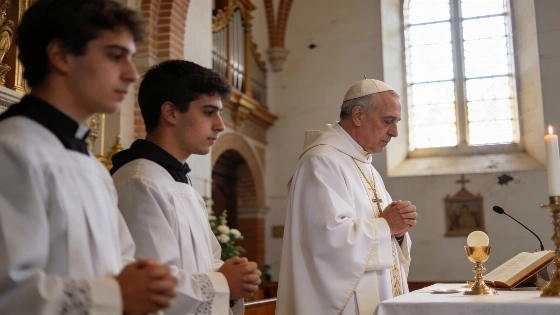
José Ángel Saiz Meneses has urged Life Teen España leaders to keep bringing the Gospel to teenagers, even when the results are not immediately visible. The archbishop of Seville delivered that message during a Eucharist at the organisation’s training meeting in the city.
Around 80 leaders and catechists from Huelva, Cádiz, Granada and Seville attended. They joined the Life Teen España team from the Diocese of Terrassa.
His homily made one demanding point. Youth evangelisation cannot be judged only by successful activities or visible short-term growth. Using the Gospel image of the sower, Saiz Meneses described the mission as work that calls for initiative, patience and trust that each effort may bear fruit later.
Around 15% of children enrolled for First Communion in Spain are reportedly not baptised, highlighting how religious socialisation is increasingly taking place later in childhood.
The sower does not wait for the soil to come to him.
That image placed the catechists’ work within the wider mission of the Church. Saiz Meneses acknowledged how difficult it is to accompany teenagers in a secularised society. Many have grown up without strong Christian references.
He connected their attitudes and doubts with deeper questions about identity, the meaning of life, love, forgiveness and the chance to start again.
For Saiz Meneses, those questions reveal a spiritual thirst. He did not call on catechists to lower their expectations. Instead, he asked them to keep working without judging the mission only by immediate results.
A conversation, a gesture or an experience during adolescence may have an effect years later. The person who planted that seed may never see what came from it.
The wider Spanish context is marked by a sharp gap between religious identity and practice. Vida Nueva, citing Funcas research from 2025, reports that about 55% of adults still identify as Catholic, while 42% were non-religious in 2024 and only 17% maintained regular religious practice. At the same time, a Fundación SM study cited by the publication found that the share of young people identifying as Catholic rose from 31.6% in 2020 to 45% in 2025.
The archbishop also put the catechists’ credibility at the centre of their work. He said those who accompany young people must first live a real relationship with Christ through prayer and the Eucharist.
Teenagers can recognise authenticity, he said. Personal witness matters more than the ability to deliver an impressive presentation.
That gives the meeting a sharper purpose than a simple exchange of pastoral techniques. Life Teen España uses dynamics, music, gatherings, training and other resources. Saiz Meneses insisted that these tools are not the final goal.
The aim is to help teenagers know Jesus Christ, discover that they are loved by God, learn to pray, belong to the Church and encounter Christ in the sacraments, especially in the Eucharist.
The mission must take place within the Church and come from the Church. The archbishop described Life Teen as an instrument of that mission and urged the group to stay close to pastors, priests, parishes, diocesan delegations and other ecclesial realities. Manuel Jiménez, the diocesan delegate for Youth Ministry, concelebrated the Eucharist.
The gathering also recognised the work that often goes unseen in youth ministry: conversations, camps, catechesis, meetings, music, prayer and travel.
Saiz Meneses thanked the leaders and catechists for those hours. He reminded them that God sees the effort even when it receives no immediate public recognition.
The celebration ended with a sending prayer for all the young people of the Archdiocese. That ending matched the message delivered in Seville.
Life Teen España cannot be judged only by attendance at attractive activities. What matters is whether those activities lead young people towards faith and life in the Church. The archbishop’s appeal was practical and demanding: keep sowing with joy, patience and enthusiasm, while staying close to the tabernacle and united with the Church.
The Seville meeting also reflects the expanding diocesan network around Life Teen España. ODISUR’s report on the formation activity identifies participants from Huelva, Cádiz, Granada and Seville. A separate ODISUR report describes a Life Teen España training day in Murcia.
Together, the reports place the initiative within a broader interdiocesan effort to equip catechists for youth ministry. They show that the Seville gathering was not an isolated parish event.
Recent statements and reports connected with the Archdiocese of Seville also show Saiz Meneses speaking about evangelisation, education and the missionary character of Christian service.
That wider pastoral focus helps explain why his message to the catechists centred on programme quality, perseverance, personal witness and communion with the Church.