Amelia Sánchez, 76, surprised Madrid’s protest camp with her energy and practical help. Her presence at Puerta del Sol marks a rare bridge between generations, as she urges young activists to stay strong in the fight against evictions.
Long before sunrise, Amelia Sánchez was already moving through Madrid. She is 76. She set out for Puerta del Sol with a clear goal. Amelia did not come as part of any group. She came as a citizen, as she put it, with "two ears, two eyes and common sense." Her reason was simple. She wanted to back the hundreds of young people camping out to protest Maricarmen’s eviction—a case that has put Spain’s housing crisis back in the spotlight.
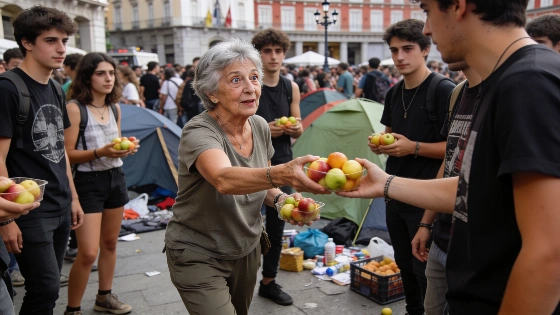
Amelia stood out right away. She weaved through the camp with fruit in one hand and water in the other. She handed out bananas and mandarins, asking, "Do you want potassium? A bit of vitamin C?" The heat was tough. Her fruit and words kept spirits up. For many, getting fruit from Amelia felt like a badge of honor. It meant you belonged.
According to official estimates, around 25,000 people joined the Madrid protest, while organizers claimed up to 300,000 participants, making it one of the largest demonstrations on housing in recent years.
Amelia’s link to Maricarmen runs deeper than age. "It’s remarkable that it took an octogenarian to spark this," she said. Maricarmen’s struggle is just one of thousands. But what hit Amelia hardest was seeing young people back in the streets. "Since 15-M, I only heard the right-wingers shouting. I thought the youth were just playing PlayStation. Seeing them here gives me life," she said. Her words cut through the noise.
Her activism comes from her own story. Amelia remembers losing her youth to early motherhood at 22, when birth control was out of reach. She and her ex-husband squeezed into a tiny room with their kids. The rest of their home became a shoe shop. "It’s hard to believe people are living like that again," she said. Her first job was at an American insurance company. Weekends off were won through protest, not given. Later, she worked as a hospital orderly. She saw how people now accept mistreatment as normal—waiting a year for a doctor, or watching housing turn into a privilege. "It makes my blood boil," she said. No sugarcoating.
Amelia did not slow down at Sol. She spent hours handing out supplies and picking up trash. She joked, "Either I stop now or the ambulance will have to take me away." Still, she would not leave. "I need this—to see people not sitting at home, indifferent. If Maricarmen’s case is the excuse, so be it." She meant every word.
The protest at Puerta del Sol quickly grew into a tent camp, with AFP and Euronews reporting about 100–150 tents set up by activists who stayed overnight to increase pressure on authorities. The movement’s demands include a freeze on rents, a ban on evictions without alternative housing, and stronger tenant protections, as highlighted by Reuters and DW.
Her message to the young was blunt. "Now you have the strength. We, the older ones, are just here to help. I want to soak up the energy of the young, because you have the power. It would hurt to see this become just a passing moment. That would mean we’ve learned nothing." She did not want this to fade.
As night fell, Amelia thought about what she would leave behind. She remembered a tombstone she once saw: "I’m leaving because I can’t stand you anymore." She prefers her own: "I fought until they got tired of me." She promised to return the next day. No rest yet.
The spark at Puerta del Sol is spreading. As reported earlier, Maricarmen’s eviction has set off a wave of protest and debate about housing rights in Spain. Old problems are back in new forms. The fight is not over.
Amelia Sánchez proves that movements are built on more than slogans. They need people who refuse to look away. Her work at Sol shows that solidarity is not about age. It is about will. When the old stand with the young, the message is clear. The fight for dignity and rights goes on. Experience and energy together keep it alive.