Andalusia enters summer with a record €271 million fire prevention plan. Emergency workers warn of incomplete teams and equipment issues. Scientists urge tailored prevention as wildfire risk intensifies.
Andalusia is entering one of its most dangerous wildfire seasons in recent memory, with emergency services stretched and experts warning that the region is a tinderbox. Despite the Junta de Andalucía allocating €271 million—a 5% increase over last year—for the Plan Infoca fire prevention and response system, frontline workers say critical gaps remain in staffing and equipment. The region’s unusually wet winter has led to dense vegetation, which, combined with early heatwaves and persistent dry winds, has created ideal conditions for fast-spreading fires.
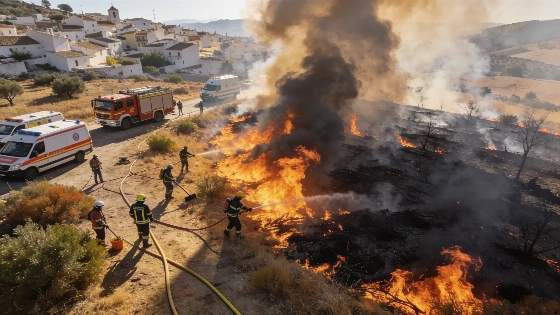
Recent incidents in Huelva, including a major blaze in the Doñana Natural Park, have already tested the system. Firefighters report that many teams are operating below required strength, with some units fielding only three to five members instead of the standard seven. Reinforcement brigades, such as the Brica units in Sevilla, Málaga, and Granada, are also understaffed, directly impacting operational efficiency during complex emergencies. In Huelva’s latest fire, only 14 of the needed 22 firefighters were available for deployment.
Alongside personnel shortages, equipment issues persist. According to María Ruzafa of Movimiento Infoca, many fire trucks remain idle due to a lack of qualified drivers, and protective gear is often inadequate for the range of emergencies crews now face. Workers are also being tasked with new responsibilities, such as flood response, without sufficient training or proper equipment. These conditions have prompted calls for improved training, better pay, and more reliable protective equipment. A demonstration is planned in Huelva on June 30 to highlight these ongoing concerns.
Authorities emphasize that the Plan Infoca now includes 4,700 professionals, 43 aircraft, and 108 fire engines—most of which have been recently upgraded. New specialized units, such as heavy machinery teams and technical fire squads, are being introduced to boost response capabilities. The plan also features a real-time digital coordination platform to streamline emergency management. Officials claim that rapid intervention keeps 85% of wildfires contained to less than one hectare, but workers argue that incomplete teams and excessive overtime undermine these results. Many firefighters report working beyond the contractual 10-hour limit during major incidents, with extra hours compensated only by rest days that are rarely taken due to ongoing staff shortages.
Scientists stress that prevention strategies must be adapted to local conditions. Experts from the University of Málaga and the University of Sevilla highlight the need for region-specific measures, such as reintroducing wild herbivores to reduce biomass and reviving traditional grazing in dehesa landscapes. They also point to the growing risk posed by rural-urban interfaces, where vacation homes and small properties now occupy former agricultural land, increasing the likelihood of fires reaching populated areas. Prescribed burns and vegetation management in winter are recommended, though these practices often lack political support due to their long-term nature.
The Junta has shifted its approach, investing more in prevention (57% of the budget by 2026) than in direct firefighting (43%). However, not all prevention work is handled by public employees, with some tasks outsourced—a point of contention among unions. The administration has signed agreements with unions to ensure year-round employment and recognize seniority, but implementation remains uneven.
Technological advances are being integrated, with the Plan Infoca’s technical unit now using severity and fuel availability indices to identify high-risk zones. Almería and Huelva are currently seen as the most vulnerable provinces, due to low rainfall and highly flammable vegetation. The need for closer collaboration between emergency managers and scientists is widely acknowledged, but experts say that political attention to long-term solutions is still lacking.
Andalusia’s situation reflects broader challenges in Spain, where climate change is intensifying wildfire risks and stretching emergency resources. The region’s experience echoes concerns raised in other parts of the country, such as Catalonia’s recent efforts to address social vulnerabilities through targeted investment, as seen in Catalonia’s initiative to support families missing out on social aid. As the summer progresses, the effectiveness of Andalusia’s expanded fire response will be closely watched, both for its immediate impact and for lessons on adapting to a changing climate.
For context, Spain has seen a steady increase in wildfire frequency and severity over the past decade, with climate models predicting further escalation. The Plan Infoca is considered one of the most advanced regional fire management systems in the country, but its success depends on adequate staffing, equipment, and public cooperation. The growing overlap between rural and urban areas, combined with shifting land use and depopulation, continues to complicate prevention efforts. As authorities and emergency workers navigate these challenges, the coming months will test the resilience of Andalusia’s fire defense strategy.