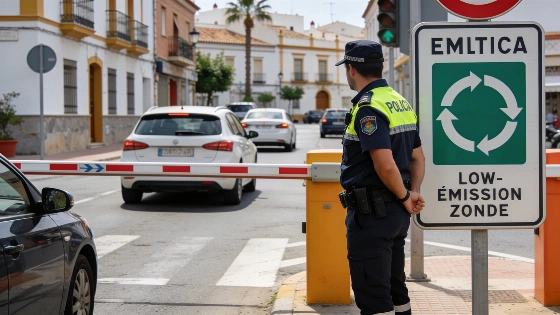
The new PP and Vox agreement in Andalusia removes regional funding for Low Emission Zones. This decision threatens the rollout of anti-pollution measures in key cities and leaves many projects stalled.
The formation of the new Andalusian government under the PP and Vox alliance has resulted in a major policy shift: the withdrawal of all regional funding for Low Emission Zones (Zonas de Bajas Emisiones, ZBE). This move directly impacts the ability of cities across the region to implement or maintain these anti-pollution areas, which are required by national law in municipalities with more than 50,000 residents.
According to the latest audit by the Cámara de Cuentas, only seven out of thirty Andalusian municipalities legally obliged to operate a ZBE have them functioning. The rest either lack technical projects, face delays, or have seen their plans stalled. The new coalition agreement explicitly states that the Junta de Andalucía will not promote, finance, subsidize, or incentivize the creation or expansion of ZBEs with its own funds. In municipalities where Vox is part of the local government, restrictions on ZBEs have already been tightened or the zones rendered ineffective.
Scientific research, such as a study led by Habtamu Beshir from University College London and published in the Journal of Economic Behavior and Organization, highlights the benefits of these zones. The study, focused on London, found that ZBEs and Ultra Low Emission Zones (ZUBE) not only reduce harmful pollutants like nitrogen dioxide and particulate matter, but also lead to measurable improvements in public health and economic savings. The research documented an 18.5% drop in sick leave, a 6.8% reduction in general health issues, and a 10.2% decrease in respiratory illnesses, alongside significant cost savings for local administrations.
Despite these findings, the implementation of ZBEs in Andalusia remains limited. The Cámara de Cuentas lists several major cities—including Granada, Huelva, Cádiz, Marbella, and Jerez de la Frontera—among those failing to meet legal requirements. Some municipalities have received public funding for technical planning, but actual deployment lags behind. In many cases, the lack of progress is attributed to insufficient staff, contractor delays, legal challenges, or ongoing revisions of urban mobility plans, rather than just financial constraints.
In Málaga, Vox representatives have publicly called for the abolition of the ZBE, arguing that it unjustifiably restricts freedom of movement and economic activity. They also point to ongoing legal disputes over the local ordinance. Meanwhile, the Cámara de Cuentas has identified widespread deficiencies even in cities where ZBEs are operational, such as Córdoba and Sevilla, noting that projects often lack proper technical documentation, clear objectives, or effective monitoring systems. None of the ten established ZBEs met the legal deadline for implementation or enforced penalties for violations, undermining their deterrent effect.
The Andalusian case is not isolated. Similar political dynamics have played out in other regions, as seen in Valencia, where the PP and Vox coalition has pushed through controversial reforms affecting social aid and tax policy. For more on these developments, see the analysis of recent legislative changes in Valencia's new social aid and tax rules.
Low Emission Zones are a key tool in European urban policy to combat air pollution and improve public health. The World Health Organization estimates that air pollution causes 4.2 million premature deaths globally each year. In Spain, national law requires all cities over 50,000 inhabitants to establish ZBEs, but enforcement and funding vary widely by region. The current situation in Andalusia highlights the challenges of implementing environmental policy amid shifting political alliances and local resistance. Without regional support, many municipalities may struggle to meet legal obligations, potentially exposing them to sanctions or further public health risks.