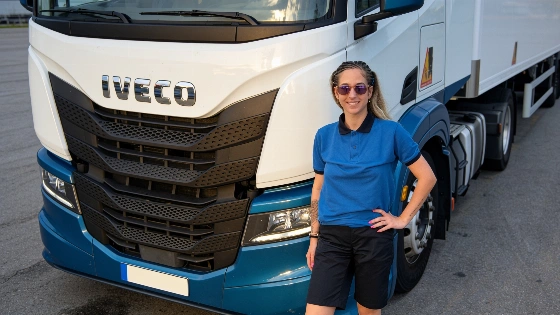
Andrea García, just 22, is now the youngest female truck driver in Spain. Her story highlights the urgent need for generational change in transport and reveals the personal ambitions driving her forward.
Andrea García, a 22-year-old from Catalonia, has become the youngest female truck driver in Spain—a distinction that puts her at the center of a sector facing a critical shortage of young talent. While youth unemployment in Spain remains stubbornly high, with rates above 25% for those aged 15 to 24 and even higher in regions like the Canary Islands and Extremadura, the road transport industry struggles to attract new generations as its workforce ages rapidly.
García’s experience exposes a paradox: despite the abundance of young people seeking work, few consider a career behind the wheel. She warns that if this trend continues, the sector could face severe disruptions in the coming decade, from supply chain breakdowns to rising consumer prices. “Everything moves by truck,” she notes, emphasizing that the looming wave of retirements among drivers is a structural problem that demands urgent solutions.
Being a young woman doesn’t mean I do the job poorly.
Her own path offers a rare note of optimism. García has not spent a single day unemployed since completing her training. After investing between €4,000 and €5,000 in the required CAP certification and C and E driving licenses, she secured a job within months. Her story demonstrates that transport can offer stable, well-paid work with increasingly balanced conditions—an opportunity many young people overlook or underestimate.
Contrary to the stereotype of endless hours on the road, García works a regular Monday-to-Friday schedule, from 14:00 to 22:00, driving a refrigerated trailer across Catalonia. She covers 200 to 250 kilometers daily and earns around €2,000 per month—a salary she considers fair for a job she genuinely enjoys. The structure allows her to maintain a personal life, a benefit she believes is often misunderstood by outsiders.
García is vocal about the value and appeal of her profession. She encourages other young people to pursue their licenses without fear, insisting that “there’s plenty of work.” She also points out areas for improvement, such as better recognition of rest periods and the need for decent public facilities for women drivers, which are often neglected.
At the heart of her journey is a personal dream: “I’d like to buy a nice two-story house with a pool, have two dogs in the garden, and own an Audi RS 7,” she shared on the podcast Rutas de Éxito. García is clear that these ambitions are hers alone, not tied to her professional identity, but they reflect the stability she is building through her work.
To reach these goals, García plans to pursue advanced studies in transport and logistics, with the aim of eventually moving into traffic management and office-based roles—positions that would allow her to better balance work and family life in the future. For her, the house, the dogs, and the Audi are not just aspirations, but tangible milestones of the security she is creating, kilometer by kilometer.
While García feels respected within her company, she has encountered outdated attitudes elsewhere. In one warehouse, an older man questioned her presence, implying she didn’t belong. Her response—“I’m a person just like you”—has become her motto. She has also faced dismissive comments about her age and gender, with some doubting her abilities simply because she is young and female. García’s answer is direct: “Being a young woman doesn’t mean I do the job poorly.”
Her determination and resilience have made her a symbol of change in a traditionally male-dominated field. As her friends describe her, García is a fighter—someone whose passion and self-confidence are breaking down barriers for the next generation of drivers.
Spain’s transport sector is not alone in facing these challenges. The need for better security and technical solutions is a recurring theme, as seen in innovations like the hidden screw that helps prevent car theft, recently discussed in an article on vehicle protection methods. For García and others like her, the future of the industry will depend on both attracting new talent and adapting to a changing world.
According to available data, the average age of Spanish truck drivers now exceeds 50, and the gender gap remains significant. Initiatives to modernize the profession and improve working conditions could help close these gaps, but stories like García’s may prove just as influential in inspiring others to follow her lead.