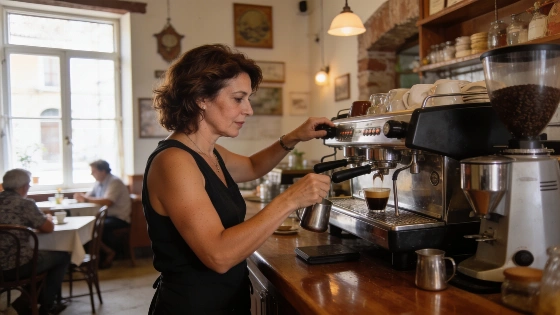
At 6 a.m., Anna Possi rises in the small town of Nebbiuno in northern Italy and prepares to open Bar Centrale, a ritual she has followed for nearly seven decades. On November 16, 2025, she turned 101, yet remains a fixture behind the counter, greeting regulars and newcomers with the discipline that has defined her life since 1958. She has described the café as family: “My bar is my family.”
Possi and her husband opened Bar Centrale on May 1, 1958, turning a modest lakeside spot into a local institution. After her husband’s death in 1974, she kept the business running, making the café both her livelihood and her anchor. Each morning, she cleans tables and organizes supplies before the first customers arrive. Her daughter Cristina and a granddaughter now help with some tasks, while Possi continues serving coffee and talking with patrons. Although she officially retired at 60 in 1984, she kept working at the café.
Her approach to longevity is straightforward: eat modestly and stay active, while keeping the mind engaged. In interviews with Italian media, Possi has described her daily routine as her personal gym, saying that walking and the daily work of cleaning and serving keep her moving. She says being useful and connected to her community gives her a sense of purpose. Her account is personal, not evidence that work or a particular routine causes exceptional longevity.
Possi’s diet is as unpretentious as her lifestyle. Breakfast is tea and a slice of homemade apple cake. Lunch is a small portion of pasta, sometimes with butter or a simple sauce of garlic, oil and chili. Dinner is usually a light bean or chickpea purée, served with stewed fruit; she eats only a little meat. Her meals are part of her own story, not a universal health prescription.
The broader demographic picture puts Possi’s key stage in context. Italy had 23,548 people aged 100 or older on January 1, 2025, more than twice the 10,158 recorded in 2009, information from figures attributed to the national statistics institute, Istat. Women accounted for roughly four in five centenarians. These figures describe a growing group of exceptionally old people; they do not establish that an individual’s diet or daily habits, including work, explain longevity.
Research into longevity also points to population-level associations, not a formula for individuals. A 2012 study of five municipalities in Sicily’s Monti Sicani area counted 19 people aged 100 to 107 among 18,328 residents, or 10.37 centenarians per 10,000 people, compared with a reported national average of 2.4 per 10,000 at the time. The study described traditional Mediterranean eating patterns, including fruit and vegetables, with relatively low saturated-fat intake. Its findings concern a specific population and cannot show that Possi’s personal routine caused her to reach 101.
Possi’s story echoes other cases of older workers who find meaning in staying active. For example, a recent report on a 48-year-old Argentine bricklayer in Spain highlighted how purpose and daily engagement can shape a working life well beyond conventional expectations.
Possi has also said she continues working to fulfill pension contributions and will only be able to access them at 105. She has received recognition from organizations including Confcommercio and FIPE, and was named a Commander of the Italian Republic. Her greeting was also featured during the opening ceremony of the Milano Cortina Winter Games in 2026. For Possi, work is a choice, not simply an obligation, and it continues to give her life structure and meaning.