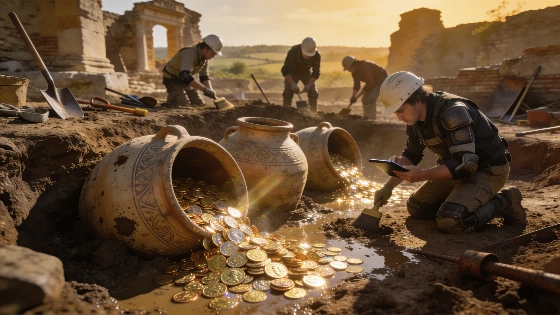
A team of archaeologists has unearthed three large ceramic vessels filled with tens of thousands of Roman coins in Senon, Lorraine. The find sheds light on how wealthy residents managed and stored money in the late Roman Empire, offering a rare glimpse into daily life nearly two millennia ago.
During a routine excavation in Senon, a town in France's Lorraine region, archaeologists made a discovery that is already being called one of the most significant finds in recent French archaeology. Beneath a residential plot, researchers uncovered three large ceramic containers, each packed with Roman coins that had remained untouched for around 1,800 years.
The dig, conducted ahead of a planned home extension, covered an area of 1,500 square meters. Within this space, the team identified not only the coin hoards but also the remains of a Roman neighborhood: stone-paved streets, domestic spaces, workshops, and advanced heating systems. According to the French National Institute for Preventive Archaeological Research (INRAP), these features point to a prosperous community, likely made up of artisans and merchants, that thrived from the Gallic period until the late Roman era.
Hidden Wealth in Plain Sight
The most striking aspect of the find was the location of the coins. Rather than being buried in haste or hidden far from view, the three hoards were placed inside homes, in carefully prepared pits, with the mouths of the vessels close to ground level. This arrangement suggests the coins were not concealed out of fear or during a crisis, but rather stored for regular access—possibly as part of a household or administrative savings system.
Two of the hoards were discovered during the recent INRAP excavation, while a third had been identified earlier by the Regional Archaeology Service. The vessels varied in size and content: one contained approximately 38 kilograms of coins, estimated at 23,000 to 24,000 pieces; another weighed around 50 kilograms, likely holding 18,000 to 19,000 coins; the third, much smaller, preserved only three coins.
Coins from a Turbulent Era
Analysis of the coins revealed faces of rulers from the so-called Gallic Empire, including Victorinus, Tetricus I, and Tetricus II—leaders who governed a breakaway state from Rome between 260 and 274 AD. The hoards themselves are believed to have been buried between 280 and 310 AD, a period marked by political instability and economic uncertainty across the Roman world.
What sets this discovery apart is not just the sheer volume of coins, but the context in which they were found. Similar hoards have been documented in the Meuse department before, but rarely with such clear evidence of deliberate, accessible storage within inhabited homes. The careful placement and lack of signs of panic suggest a routine practice rather than a desperate act.
Unanswered Questions and Historical Clues
Despite the apparent accessibility of the hoards, none were ever retrieved by their owners. According to INRAP, a major fire swept through the neighborhood in the early fourth century, followed by a brief period of reoccupation and then another devastating blaze. By the mid-fourth century, the area was abandoned for good, leaving the coins undisturbed until their modern discovery.
The Senon find offers a rare window into the financial habits and daily realities of Roman provincial life. It also raises questions about how wealth was managed, protected, and ultimately lost during times of upheaval. As researchers continue to study the coins and the site, the story of Senon's lost fortunes may help illuminate broader patterns of economic and social change at the twilight of the Roman Empire.