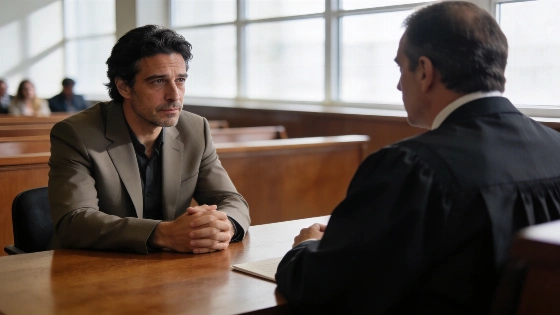
Spanish Prime Minister's Brother Denies Pressure Allegations in Badajoz Appointment. David Sánchez told the court he had no influence on the competition at the Diputación de Badajoz. He was questioned solely by lawyers. The inquiry is focused on potential corruption linked to his appointment.
A high-profile court case over possible irregularities in an appointment at the Diputación de Badajoz continues in Badajoz. This time, the focus is on David Sánchez — the brother of Spain’s current Prime Minister. At the provincial court hearing, he categorically denied accusations that he could have influenced the selection process or knew the results in advance. According to Sánchez, he had neither access to administrative information nor the ability to affect the process.
The interrogation took place under heightened attention: David Sánchez answered only his lawyer’s questions, avoiding discussion of appointment procedure details. During the hearing, he stressed that he did not participate in changes to the vacancy conditions and was not involved in how the job requirements were formulated. He denied allegations that the terms of the selection process had supposedly been tailored to suit his interests or those of acquaintances.
The court paid particular attention to correspondence between Sánchez and his friend Luis Carrero, who ultimately secured the contested position. In one email sent in October 2023, Sánchez informed Carrero about the possible opening of a new vacancy. However, the defendant claims this was only based on rumors, not any concrete decisions. Later, Carrero himself clarified that he had no official information about the competition. Sánchez insists he had no access to internal data and could not influence the proceedings.
During the proceedings, the conditions of Sánchez’s employment at the Diputación de Badajoz were also discussed. He stated that his workplace changed several times: initially he was given a private office at the Conservatory, then, after the pandemic, he was forced to use shared spaces until he was transferred to another communal office. The court also inquired about the change in his job title—the prosecution claims this could have been done to tailor the vacancy to Sánchez’s personal profile, but he denied this explanation.
David Sánchez faces up to three years in prison on charges of abuse of power and influence peddling. His testimony followed statements by the former head of the Diputación de Badajoz, Miguel Ángel Gallardo, and more than 40 witnesses, including officers from the Civil Guard’s UCO unit who compiled investigation materials. It is important to note that the case has drawn attention not only because of the accused’s profile, but also due to its potential impact on the reputation of public institutions.
The context of the case highlights how sensitive the issue of transparency in government appointments is in Spain. In recent years, court cases involving corruption schemes and abuse of power in public bodies have become increasingly prominent. For comparison, the contribution of José Carlos Gómez Villamandos to university system reforms was recently discussed in Andalusia—read more about this in the article on changes in the leadership of the region’s universities. Such cases show that issues of personnel policy and transparency remain at the center of public attention.
For reference: The Diputación de Badajoz is a key governing body of the province, responsible for budget allocation and personnel policy. In Spain, such cases often become topics of public and political discussion, especially when they involve relatives of high-ranking officials. According to RUSSPAIN, legal proceedings related to corruption and abuse of power have increased significantly in recent years, reflecting a broader demand for transparency and accountability in public institutions.