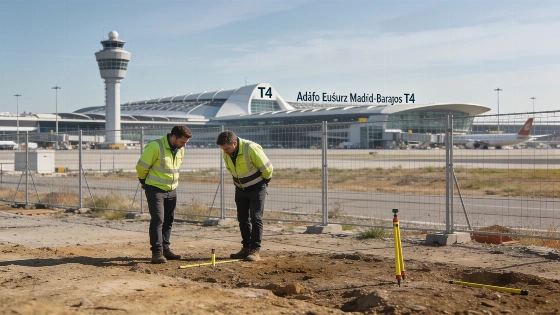
Spain’s leading construction groups are competing for the first major works at Barajas. The tenders, worth more than €146 million combined, are intended to increase capacity at T4 and T4S.
Three new aircraft positions at Madrid-Barajas are at the centre of the airport’s first major expansion tenders. Aena has received competing offers for two projects at terminals T4 and T4S, with a combined value above €146 million. The works form part of a wider plan to raise the airport’s capacity from nearly 70 million to 90 million passengers a year through investment exceeding €4 billion over the coming years.
The largest contract covers the North Platform of T4. Valued at €89.97 million and scheduled to last 35 months, it has attracted Acciona Construcción, Obrascon Huarte Lain, Sacyr Construcciones and Vías y Construcciones.
The Spanish government approved DORA III on 15 September 2026. Of the €13 billion investment programme for 2027–2031, Madrid-Barajas accounts for €4.477 billion, the largest allocation in Aena’s airport network.
Ferrovial Construcción is bidding with Padecasa Obras y Servicios. Other proposals come from an alliance of Matias Arrom Bibiloni, Sampol Ingeniería y Obra and Coexa, and from a consortium made up of Compañía General de Construcción Abaldo, BIC Restauración y conservación, Infra Conel and Llorente Electricidad.
The project covers more than aircraft parking. It includes new remote stands, wider taxiways and utility ducts leading to the complex’s new electrical substation, as well as urbanisation roads, conduits and galleries. The Plant Separadora de Hidrocarburos (PSH) and the Pabellón de Estado car park will also be relocated. Aena has divided the work into five phases to keep it compatible with airport operations.
That constraint will shape the construction schedule: the airport must expand while aircraft and passengers continue to move through the site. Reports by Expansión and Europa Press describe the tenders as the first major construction packages launched at Barajas under the new investment cycle. Market interest has extended to roughly seven or eight potential consortiums across the initial works.
Barajas is the main beneficiary of Aena’s current investment programme. The plan assigns €4.477 billion to Madrid, compared with €1.765 billion for Barcelona-El Prat, underlining the priority given to the capital’s airport in the 2027–2031 cycle.
The second tender covers the South Pier of T4S and is worth €56.5 million, with a 24-month execution period. Acciona Construcción, Obrascon Huarte Lain, Sacyr Construcciones and Vías y Construcciones are competing again, joined by Eiffage Infraestructuras and Elecnor Servicios y Proyectos.
Two additional alliances have submitted proposals for the T4S project. One brings together Matias Arrom Bibiloni, Sampol Ingeniería y Obra and Avintia Proyectos y Construcciones. The other combines Compañía General de Construcción Abaldo with Gestión y Ejecución Obra Civil.
Aena’s Diseño Funcional para la Ampliación de las Terminales T4-T4S y zonas asociadas identifies a need for more capacity for non-Schengen traffic. The plan extends the T4S pier and processor northwards within the existing architectural configuration, while also changing the boarding area on the southern side. The South Pier would be lengthened by 36 metres, creating three new contact positions with boarding bridges and expanding the boarding area on level P10.
The changes are intended to let more aircraft use contact positions while preserving the terminal’s architectural integrity. Aena also cites improvements to passenger experience and operational efficiency, although both projects remain at the tender stage. The wider DORA III programme refers to an expanded T4, a new control annex, changes to the T1-T3 terminal complex and preparation for future rail connections.
The scale of the programme places these contracts at the front of Aena’s broader airport strategy. For comparison, the company’s infrastructure decisions have appeared alongside other public-pressure stories covered in earlier reporting. The Barajas tenders, however, centre on capacity, construction sequencing and airside coordination.
The government’s approval of DORA III sets the investment and airport-charge framework through 2031. According to reporting on the government decision and Aena’s plan, the programme will be financed through Aena’s own resources rather than Spain’s state budget. The framework also provides for an annual airport-fee increase of 0.33%.
The T4 platform contract carries the larger financial weight, while the T4S extension would directly add three contact positions for non-Schengen traffic. Together, the tenders turn Aena’s expansion roadmap into specific competitive projects, but they do not represent completed works. The planned capacity increase depends first on the procurement results, followed by 35 months of phased work at T4 and 24 months at T4S. On the available facts, Barajas has made a substantial start to its expansion, but delivery is still ahead.