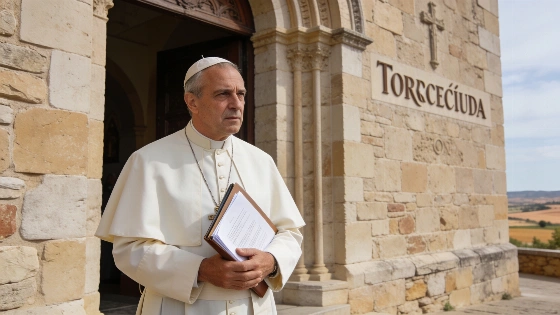
The bishop of Barbastro-Monzón accuses Opus Dei of withholding the original contract for an 11th-century Virgin statue. The legal fight over the Torreciudad sanctuary grows, with the diocese demanding the image’s return.
The fight over the 11th-century Virgin of the Angels statue has reached a new level. Bishop Ángel Pérez Pueyo of Barbastro-Monzón now openly accuses Opus Dei of failing to produce the original contract that would justify moving the statue from its historic hermitage. The missing document sits at the center of a legal and church standoff that has dragged on for years, with neither side willing to give ground.
Opus Dei says all key legal documents are available online, including a notarial act that refers to a 1966 agreement between then-bishop Jaime Flores and Opus representatives. The diocese, however, insists the actual contract—supposedly authorizing the statue’s permanent transfer to the new Torreciudad sanctuary—has never been handed over, despite repeated requests. According to diocesan officials, neither the cathedral chapter’s records nor the diocesan archives show any sign of such authorization or a permanent transfer of ownership or use.
On September 5, 2026, the statue of the Virgin of Torreciudad returned to its thousand-year-old hermitage for the first time in decades, albeit only for a few hours during a major pilgrimage event.
— Infovaticana
This is about more than paperwork. Who controls the statue is at the heart of a wider struggle over the Torreciudad sanctuary, a conflict that has simmered between the diocese and Opus Dei since 2020. The Vatican stepped in by appointing Archbishop Alejandro Arellano as pontifical commissioner, but no final decision came before Pope Francis died. The resulting uncertainty has only deepened the standoff.
In recent weeks, Bishop Pérez Pueyo has stepped up his campaign, accusing Opus Dei of illegally keeping the statue and arguing that the historical and legal record does not support claims that the local community ever gave up its custodianship. The diocese points to a 1962 contract in which it ceded the hermitage land to Opus Dei’s real estate company, Inmobiliaria General Castellana, S. A., but with a clear condition: the statue was not to be removed from its original site.
According to reports in the Catholic press, the Torreciudad sanctuary attracts around 200,000 visitors annually, highlighting the significant public and pastoral impact of the ongoing dispute over the statue and its location.
— Katholisch
Despite this, in 1975 Opus Dei took the statue to Madrid for restoration and never returned it to the hermitage. Instead, it was installed in the new Torreciudad sanctuary. The bishop at the time, Ambrosio Echebarría, formally objected, warning Opus Dei’s Spanish vicar that the move lacked diocesan approval and demanding the statue’s return. Opus Dei responded with notarial testimony, but the original contract has never surfaced.
With the bishop having already given up management of the sanctuary and the right to appoint its rector, the dispute now centers on the statue itself. Pérez Pueyo has said that if the pontifical commissioner’s final decision does not require the statue’s return, he will resign. The diocese says it is willing to allow temporary transfers of the statue for pastoral reasons, but only after it is restored to its original home.
This fight comes as Opus Dei’s influence within the Church has waned. Pope Francis reduced its status to that of a simple association of priests, placing it under the authority of the Dicastery for the Clergy and local bishops. That change has left Opus Dei with less autonomy and leverage in disputes like Torreciudad.
Adding to the tension, a series of unpublished letters between Pope Francis and the Barbastro bishop have surfaced. In them, the pope warned of “mafia-like intrigues” around the sanctuary and urged resistance to pressure from the ultraconservative group. The next move now belongs to León XIV, whose position on the Torreciudad dispute is still unknown.
As the legal and church battle drags on, the missing contract is more than a technicality—it is the key to Opus Dei’s claim and the diocese’s resistance. The fact that the statue has been outside its original hermitage for fifty years does not, in the diocese’s view, give Opus Dei any legitimate right to keep it. The case echoes other church property disputes in Spain, where paperwork and history often collide. For those watching, the unresolved fate of the Virgin of the Angels shows that in the Spanish Church, power struggles are rarely settled by faith alone. As seen in the previous investigation into church and state tensions, the real fight often happens in legal archives and Vatican offices.